

Rejs morski · 06.08.2028 – 27.08.2028 · 21 nocy
21 nocy z Lomé
Trasa i informacje o rejsie
Premium- Rzym (Civitavecchia)
- Livorno
- Livorno
- Porto Santo Stefano
- Sorrento, Capri
- Trapani
- Syracuse
- Crotone
- Kotor
- Wenecja
- Miedź
- Zadar
- Split
- Dubrownik
- Chania (Souda), Kreta
- Syros
- Mykonos
- Kusadasi (Efez)
- Patmos
- Pireus (Ateny)
| Data | Port | Przypłynięcie | Wypłynięcie |
|---|---|---|---|
| 06.08.2028 |
Rzym (Civitavecchia)
Włochy
|
— | 18:00 |
| 07.08.2028 |
Livorno
Włochy
|
07:30 | — |
| 08.08.2028 |
Livorno
Włochy
|
— | 20:00 |
| 09.08.2028 |
Porto Santo Stefano
|
08:00 | 16:00 |
| 10.08.2028 |
Sorrento, Capri
Włochy
|
08:00 | 18:00 |
| 11.08.2028 |
Trapani
Włochy
|
08:30 | 17:00 |
| 12.08.2028 |
Syracuse
Włochy
|
09:00 | 19:00 |
| 13.08.2028 |
Crotone
Włochy
|
08:00 | 15:00 |
| 14.08.2028 |
Kotor
Czarna Góra
|
10:00 | 21:00 |
| 15.08.2028 |
Dzień na morzu
|
— | — |
| 16.08.2028 |
Wenecja
Włochy
|
06:00 | 18:00 |
| 17.08.2028 |
Miedź
Slovenia
|
08:00 | 20:00 |
| 18.08.2028 |
Zadar
Chorwacja
|
09:00 | 20:00 |
| 19.08.2028 |
Split
Chorwacja
|
08:00 | 22:00 |
| 20.08.2028 |
Dubrownik
Chorwacja
|
08:00 | 20:00 |
| 21.08.2028 |
Dzień na morzu
|
— | — |
| 22.08.2028 |
Chania (Souda), Kreta
Grecja
|
08:00 | 20:00 |
| 23.08.2028 |
Syros
Grecja
|
08:00 | 22:00 |
| 24.08.2028 |
Mykonos
Grecja
|
08:00 | 20:00 |
| 25.08.2028 |
Kusadasi (Efez)
Turcja
|
08:00 | 22:00 |
| 26.08.2028 |
Patmos
Grecja
|
08:00 | 18:00 |
| 27.08.2028 |
Pireus (Ateny)
Grecja
|
05:00 | — |
-
 Dzień 1: 18:00
Rzym (Civitavecchia) / Włochy
Rzym – jedno z najstarszych miast świata, niegdyś stolica Cesarstwa Rzymskiego, dziś stolica Włoch. Położony na siedmiu wzgórzach nad Tybrem, zachwyca pięknem i majestatem, którego nie da się oddać słowami – trzeba tu być. Każda rzeźba, fontanna czy budowla to dzieło sztuki pozostawione przez dawnych mistrzów. Najsłynniejsze atrakcje, które przyciągają turystów, to Koloseum – miejsce dawnych walk gladiatorów, Fontanna di Trevi, Schody Hiszpańskie, Bazylika św. Piotra – największy kościół Europy, a także Fora Cesarskie i Forum Romanum.
-
 Dzień 2: 07:30
Livorno / Włochy
Livorno is a port city on the Ligurian Sea on the western coast of Tuscany, Italy. It is the capital of the Province of Livorno, having a population of 158,493 residents in December 2017. It has traditionally been known in English as Leghorn.
The origins of Livorno are controversial, although the place was inhabited since the Neolithic Age as shown by worked bones, pieces of copper and ceramic found on the Livorno Hills in a cave between Ardenza and Montenero. The construction of the Via Aurelia coincided with the occupation of the region by the Romans, who left traces of their presence in the toponyms and ruins of towers. The natural cove called Liburna, later transformed into Livorna, before becoming Livorno, is a reference to the type of ship, the liburna, used by Roman navy. Others ancient toponyms include: Salviano (Salvius), Antignano (Ante ignem) which was the place situated before Ardenza (Ardentia) where were the beacons for the ships directed to Porto Pisano.
The name Livorna is mentioned for the first time in 1017 as a small coastal village, the port and the remains of a Roman tower. In 1077, a tower was built by Matilda of Tuscany. The Republic of Pisa owned Livorno from 1103 and built a quadrangular Fort called Quadratura dei Pisani ("Quarter of the Pisans") to defend the port. Porto Pisano was destroyed after the crushing defeat of the Pisan fleet in the Battle of Meloria in 1284. In 1399, Pisa sold Livorno to the Visconti of Milan, in 1405 it was sold to the Republic of Genoa and on 28 August 1421 it was bought by the Republic of Florence.
Between 1427 and 1429, a census counted 118 families in Livorno, including 423 persons. Monks, Jews, military personnel, and the homeless were not included in the census. The only remainder of medieval Livorno is a fragment of two towers and a wall, located inside the Fortezza Vecchia.
-
Dzień 3: 20:00
Livorno / Włochy
Livorno is a port city on the Ligurian Sea on the western coast of Tuscany, Italy. It is the capital of the Province of Livorno, having a population of 158,493 residents in December 2017. It has traditionally been known in English as Leghorn.
The origins of Livorno are controversial, although the place was inhabited since the Neolithic Age as shown by worked bones, pieces of copper and ceramic found on the Livorno Hills in a cave between Ardenza and Montenero. The construction of the Via Aurelia coincided with the occupation of the region by the Romans, who left traces of their presence in the toponyms and ruins of towers. The natural cove called Liburna, later transformed into Livorna, before becoming Livorno, is a reference to the type of ship, the liburna, used by Roman navy. Others ancient toponyms include: Salviano (Salvius), Antignano (Ante ignem) which was the place situated before Ardenza (Ardentia) where were the beacons for the ships directed to Porto Pisano.
The name Livorna is mentioned for the first time in 1017 as a small coastal village, the port and the remains of a Roman tower. In 1077, a tower was built by Matilda of Tuscany. The Republic of Pisa owned Livorno from 1103 and built a quadrangular Fort called Quadratura dei Pisani ("Quarter of the Pisans") to defend the port. Porto Pisano was destroyed after the crushing defeat of the Pisan fleet in the Battle of Meloria in 1284. In 1399, Pisa sold Livorno to the Visconti of Milan, in 1405 it was sold to the Republic of Genoa and on 28 August 1421 it was bought by the Republic of Florence.
Between 1427 and 1429, a census counted 118 families in Livorno, including 423 persons. Monks, Jews, military personnel, and the homeless were not included in the census. The only remainder of medieval Livorno is a fragment of two towers and a wall, located inside the Fortezza Vecchia.
-
Dzień 4: 08:00–16:00
Porto Santo Stefano
-
 Dzień 5: 08:00–18:00
Sorrento, Capri / Włochy
Sorrento is a town overlooking the Bay of Naples in Southern Italy. A popular tourist destination due to its variety of small antique shops and location on the Amalfi Coast, it can be reached easily from Naples and Pompeii as it is at the south-eastern end of the Circumvesuviana rail line. The town is most commonly known for its small shops selling an arrangement of ceramics, lacework and marquetry (woodwork).
The Sorrentine Peninsula has views of Naples, Vesuvius and the Isle of Capri. The Amalfi Drive, connecting Sorrento and Amalfi, is a narrow road that threads along the high cliffs above the Tyrrhenian Sea.
Ferries and hydrofoils connect the town to Naples, Amalfi, Positano, Capri and Ischia. Sorrento's sea cliffs and luxury hotels have attracted celebrities including Enrico Caruso and Luciano Pavarotti.
Limoncello, a digestif made from lemon rinds, alcohol, water and sugar, is produced in Sorrento. Other agricultural production includes citrus fruit, wine, nuts and olives.
-
 Dzień 6: 08:30–17:00
Trapani / Włochy
-
 Dzień 7: 09:00–19:00
Syracuse / Włochy
-
 Dzień 8: 08:00–15:00
Crotone / Włochy
-
 Dzień 9: 10:00–21:00
Kotor / Czarna Góra
Kotor is a coastal town in Montenegro. It is located in a secluded part of the Gulf of Kotor. The city has a population of 13,510 and is the administrative center of Kotor Municipality.
The old Mediterranean port of Kotor is surrounded by fortifications built during the Venetian period. It is located on the Bay of Kotor (Boka Kotorska), one of the most indented parts of the Adriatic Sea. Some have called it the southern-most fjord in Europe, but it is a ria, a submerged river canyon. Together with the nearly overhanging limestone cliffs of Orjen and Lovćen, Kotor and its surrounding area form an impressive landscape.
Since the early 2000s Kotor has seen an increase in tourists , many of them coming by cruise ship. Visitors are attracted by the natural environment of the Gulf of Kotor and by the old town of Kotor. Kotor is part of the World Heritage Site dubbed the Natural and Culturo-Historical Region of Kotor.
The fortified city of Kotor was also included in UNESCO's World Heritage Site list as part of Venetian Works of Defence between 15th and 17th centuries: Stato da Terra – western Stato da Mar in 201
-
Dzień 10:
Dzień na morzu / Morze
-
 Dzień 11: 06:00–18:00
Wenecja / Włochy
Wenecja — najbardziej znane i niezwykłe miasto na świecie. Znajduje się na północy Włoch, na wybrzeżu Morza Adriatyckiego. Teren miasta przecina ponad 150 kanałów i strumieni, nad którymi przerzucono ponad 400 mostów.
Wenecja — miasto kurortowe, które jest centrum międzynarodowej turystyki o światowym znaczeniu, miejscem organizacji wystaw artystycznych i architektonicznych oraz międzynarodowych festiwali filmowych. Zupełnie niezwykła atmosfera panująca w mieście zachwyca od pierwszego spojrzenia. Wąskie uliczki z małymi, przytulnymi kawiarenkami, sunące gondole i serenady gondolierów wprowadzają w romantyczny nastrój i przyciągają zakochanych z całego świata.
-
 Dzień 12: 08:00–20:00
Miedź / Slovenia
Koper is the fifth largest city in Slovenia. Located in the southwestern part of the country, approximately five kilometres (3.1 miles) south of the border with Italy and 20 kilometers (12 miles) from Trieste, Koper is the largest coastal city in the country. It is bordered by the satellite towns of Izola and Ankaran, and anchors the Istrian region. With a unique ecology and biodiversity, it is considered an important national natural resource. It is the oldest recorded urban settlement in Slovenia. The city's Port of Koper is the major contributor to the economy of the eponymous city municipality. With only one percent of Slovenia having a coastline, the influence that the Port of Koper also has on tourism was a factor in Ankaran deciding to leave the municipality in a referendum in 2011 to establish its own. The city is a destination on a number of Mediterranean cruising lines. In 2016, the city expects 65 cruise ship arrivals (for example: Norwegian Spirit, MSC Magnifica, Norwegian Jade, MS Rhapsody of the Seas...) with the season spanning from March to December. Koper is the main urban centre of the Slovenian Istria, with a population of about 25,000.
-
 Dzień 13: 09:00–20:00
Zadar / Chorwacja
-
 Dzień 14: 08:00–22:00
Split / Chorwacja
Split – perła Dalmacji
Split to drugie największe miasto Chorwacji, położone nad Adriatykiem. Jego symbolem jest Pałac Dioklecjana, wpisany na listę UNESCO, otoczony wąskimi uliczkami i katedrą św. Duje.
Miasto tętni życiem na nadmorskiej promenadzie Riva, pełnej kawiarni i restauracji. W okolicy czekają plaże, m.in. słynna Bacvice.
Split to także ważny port, skąd łatwo popłynąć na chorwackie wyspy – Hvar, Brač czy Korčulę. Atmosfera śródziemnomorska i dalmatyńska kuchnia sprawiają, że Split to idealne miejsce na urlop.
-
 Dzień 15: 08:00–20:00
Dubrownik / Chorwacja
Dubrovnik is a Croatian city on the Adriatic Sea. It is one of the most prominent tourist destinations in the Mediterranean Sea, a seaport and the centre of Dubrovnik-Neretva County. Its total population is 42,615 (census 2011). In 1979, the city of Dubrovnik joined the UNESCO list of World Heritage sites.
The prosperity of the city was historically based on maritime trade; as the capital of the maritime Republic of Ragusa, it achieved a high level of development, particularly during the 15th and 16th centuries, as it became notable for its wealth and skilled diplomacy.
In 1991, after the break-up of Yugoslavia, Dubrovnik was besieged by Serbian and Montenegrin soldiers of the Yugoslav People's Army (JNA) for seven months and suffered significant damage from shelling. After repair and restoration works in the 1990s and early 2000s, Dubrovnik re-emerged as one of the top tourist destinations in the Mediterranean.
-
Dzień 16:
Dzień na morzu / Morze
-
 Dzień 17: 08:00–20:00
Chania (Souda), Kreta / Grecja
Chania (Souda), Kreta — Urok i historia
Chania, położona na północno-zachodnim wybrzeżu Krety, przyciąga podróżnych swoją historyczną atmosferą i malowniczym weneckim portem. Wąskie uliczki, budynki i przytulne kawiarnie tworzą unikalny urok, łącząc elementy architektury weneckiej i osmańskiej.
Souda to ważny port morski i promowy, położony w zatoce Souda, na wschód od Chanii. Port odgrywa kluczową rolę w sieci transportowej wyspy i ma strategiczne znaczenie dla regionu. W okolicach Chanii znajdują się stanowiska archeologiczne, w tym pozostałości starożytnych miast, a także atrakcje przyrodnicze, takie jak jaskinie i pomniki z czasów II wojny światowej.
-
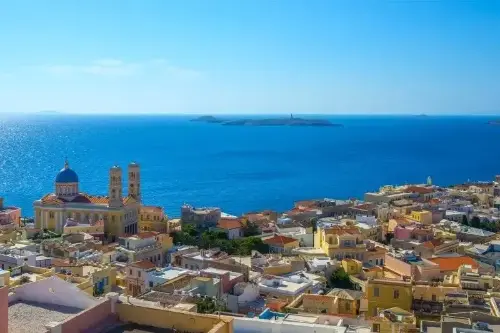 Dzień 18: 08:00–22:00
Syros / Grecja
Syros to malownicza wyspa w archipelagu Cyklad, znana z bogatej historii i zróżnicowanej architektury. Jej stolica, Ermoupoli, to jedno z nielicznych greckich miast, w których bizantyjskie kościoły sąsiadują z neoklasycznymi rezydencjami. Dawniej najważniejszy ośrodek morski Grecji, dziś nadal zachowuje elegancki i kulturowo bogaty charakter.
Wyspa idealna dla podróżnych szukających nie tylko plażowego relaksu, ale i autentycznych wrażeń. Urokliwe zatoczki, malownicze szlaki i lokalna kuchnia — od świeżych owoców morza po "lagano", tradycyjny chleb pieczony z oliwą. Ciekawostka: w Ermoupoli znajduje się jeden z najstarszych teatrów w Grecji — teatr Apollon, wzorowany na mediolańskiej La Scali.
-
 Dzień 19: 08:00–20:00
Mykonos / Grecja
Słynna, nowoczesna wyspa Mykonos przyciąga turystów swoim urokiem. Trudno oprzeć się widokowi lazurowego morza i skąpanego w słońcu białego miasta. Mykonos to wyspa kontrastów – biel domów, błękit głębin i kolorowe okna. Wśród atrakcji warto wspomnieć liczne kościoły i muzea, m.in. Muzeum Archeologiczne z amforą przedstawiającą scenę z Trojańskim koniem.
Mykonos to modny kurort i ulubione miejsce bohemy. To tutaj można zanurzyć się w wir luksusowych usług, rozrywek i nocnego życia. Ale wyspa ma także spokojniejsze oblicze – czekają na Ciebie urokliwe, ciche zakątki, idealne do relaksu i odpoczynku.
-
 Dzień 20: 08:00–22:00
Kusadasi (Efez) / Turcja
Kusadasi kiedyś było małą wioską rybacką na wybrzeżu Morza Egejskiego, dziś zaś jest miastem portowym z dobrze rozwiniętą infrastrukturą. Co więcej, dzięki luksusowym hotelom, restauracjom, klubom nocnym i doskonałej obsłudze Kusadasi przekształciło się w modny turecki kurort.
Miasto otrzymało swoją nazwę, która w tłumaczeniu brzmi „Wyspa ptaków”, dzięki niewielkiej wyspie przylegającej do wybrzeża, dokąd przez wiele stuleci zlatują się gniazdować różne gatunki ptaków.
Miłośnicy spokojnej atmosfery mogą znaleźć wiele ustronnych zakątków, pospacerować uliczkami i wypocząć na piaszczystej plaży. Jasne światła nocnego miasta, liczne dyskoteki, bary i restauracje dają możliwość świetnej zabawy.
Turyści preferujący aktywne formy sportu mogą spróbować swoich sił w windsurfingu, nurkowaniu lub siatkówce plażowej.
-
 Dzień 21: 08:00–18:00
Patmos / Grecja
Patmos is a small Greek island in the Aegean Sea, most famous for being the location of the vision given to the disciple John in the Book of Revelation in the New Testament, and where the book was written.
One of the northernmost islands of the Dodecanese complex, it has a population of 2,998 and an area of 34.05 km2(13.15 sq mi). The highest point is Profitis Ilias, 269 metres (883 ft) above sea level. The municipality of Patmos, which includes the offshore islands of Arkoi (pop. 44), Marathos (pop. 5), and several uninhabited islets, has a total population of 3,047 (2011 census) and a combined land area of 45.039 square kilometres (17.390 sq mi). It is part of the Kalymnos regional unit.
Patmos' main communities are Chora (the capital city), and Skala, the only commercial port. Other settlements are Grikou and Kampos. The churches and communities on Patmos are of the Eastern Orthodox tradition. The mayor of Patmos is Gregory Stoikos.
-
 Dzień 22: 05:00
Pireus (Ateny) / Grecja
Pireus to stare miasto portowe, będące portem Aten i jednocześnie największym portem Grecji w dniu dzisiejszym. Pireus stanowi część wielkich Aten, które mogą poszczycić się bogactwem atrakcji, w tym unikalnymi zabytkami narodowej sztuki plastycznej.
Ponad dwieście muzeów i galerii, w tym Muzeum Historii Uniwersytetu, Muzeum Archeologiczne Keramejkos i wiele innych, gościnnie powita Państwa w swoich murach i zapozna z kulturą tej okolicy.
Organizator
Biznes i Turystyka Piotr Skupiewski
- ul. Łukowa 41, 32-823 Szczepanów
- NIP 8691148381
- REGON 850455159
- +48 576 977 555
- +48 570 700 273
Organizator jest wpisany do Centralnej Ewidencji Organizatorów Turystyki i Przedsiębiorców Ułatwiających Nabywanie Powiązanych Usług Turystycznych. Posiada gwarancję ubezpieczeniową UNIQA nr 3800003856, ważną od 5 maja 2026 r. do 4 maja 2027 r. Suma gwarancyjna wynosi 379 404,00 zł. Organizator odprowadza składki do Turystycznego Funduszu Gwarancyjnego i Turystycznego Funduszu Pomocowego.
Częste pytania
Rekomendujemy przylot dzień przed rozpoczęciem rejsu.
- W porcie należy stawić się 2–3 godziny przed wypłynięciem.
- Zamawiając transfer lotnisko–port, zaplanuj co najmniej 5 godzin między lądowaniem a planowanym wypłynięciem.
Masz jeszcze pytania?
Pomożemy wybrać rejs i odpowiemy na Twoje pytania.