

Sea cruise · 13.08.2027 – 25.08.2027 · 12 nights
12 nights, from Portsmouth
Cabin prices and availabilityRoute and cruise information
Premium- Portsmouth
- Falmouth
- Dublin
- Belfast
- Torshavn
- Runavík Runavík
- Eskifjordur
- Husavik
- Akureyri
- Isafjordur
- Reykjanesbaer
- Reykjavik
| Date | Port | Arrival | Departure |
|---|---|---|---|
| 13.08.2027 |
Portsmouth
Dominica
|
— | 17:00 |
| 14.08.2027 |
Falmouth
Jamaica
|
07:00 | 15:00 |
| 15.08.2027 |
Dublin
Ireland
|
09:30 | 22:00 |
| 16.08.2027 |
Belfast
Great Britain
|
08:00 | 22:00 |
| 17.08.2027 |
Day at sea
|
— | — |
| 18.08.2027 |
Torshavn
Faroe Islands
|
08:00 | 22:00 |
| 19.08.2027 |
Runavík Runavík
Faroe Islands
|
07:30 | 13:30 |
| 20.08.2027 |
Eskifjordur
Iceland
|
09:00 | 20:00 |
| 21.08.2027 |
Husavik
Iceland
|
13:00 | 20:00 |
| 22.08.2027 |
Akureyri
Iceland
|
08:00 | 22:00 |
| 23.08.2027 |
Isafjordur
Iceland
|
11:00 | 18:00 |
| 24.08.2027 |
Reykjanesbaer
|
08:00 | 22:00 |
| 25.08.2027 |
Reykjavik
Iceland
|
07:00 | — |
-
Day 1: 17:00
Portsmouth / Dominica
-
 Day 2: 07:00–15:00
Falmouth / Jamaica
Falmouth (Jamaica) – a Caribbean gem with colonial charm
Falmouth is a vibrant town on Jamaica’s northern coast, where the warm waves of the Caribbean Sea meet the atmosphere of a colonial past. As one of the most authentic historic towns in the region, Falmouth is renowned for its well-preserved 18th-century Georgian architecture, old plantation estates, and cultural sites. Its streets breathe history and tropical color.
For travelers seeking the true spirit of Jamaica, this town is a perfect starting point: from here, it's easy to reach the white-sand beaches of Montego Bay or the picturesque waterfalls of Ocho Rios. Visitors can enjoy leisurely walks, colorful local cuisine, plantation tours, and relaxation in the glowing lagoon. Falmouth is a place where Caribbean beauty blends harmoniously with colonial elegance. -
 Day 3: 09:30–22:00
Dublin / Ireland
Dublin is the capital of, and largest city in, Ireland. It is on the east coast of Ireland, in the province of Leinster, at the mouth of the River Liffey, and is bordered on the south by the Wicklow mountains. It has an urban area population of 1,173,179, while the population of the Dublin Region (formerly County Dublin), as of 2016, was 1,347,359, and the population of the Greater Dublin area was 1,904,806.
There is archaeological debate regarding precisely where Dublin was established by Celtic-speaking people in the 7th century AD. Later expanded as a Viking settlement, the Kingdom of Dublin, the city became Ireland's principal settlement following the Norman invasion. The city expanded rapidly from the 17th century and was briefly the second largest city in the British Empire before the Acts of Union in 1800. Following the partition of Ireland in 1922, Dublin became the capital of the Irish Free State, later renamed Ireland.
Dublin is a historical and contemporary centre for education, the arts, administration and industry. As of 2018 the city was listed by the Globalization and World Cities Research Network (GaWC) as a global city, with a ranking of "Alpha -", which places it amongst the top thirty cities in the world.
-
 Day 4: 08:00–22:00
Belfast / Great Britain
Belfast is a port city in the United Kingdom and the capital city of Northern Ireland, on the banks of the River Lagan on the east coast of Ireland. It is the largest city in Northern Ireland and second largest on the island of Ireland. It had a population of 333,871 in 2015.
By the early 1800s Belfast was a major port. It played a key role in the Industrial Revolution, becoming the biggest linen producer in the world, earning it the nickname "Linenopolis". By the time it was granted city status in 1888, it was a major centre of Irish linen production, tobacco-processing and rope-making. Shipbuilding was also a key industry; the Harland and Wolff shipyard, where the RMS Titanic was built, was the world's biggest shipyard. It also has a major aerospace and missiles industry. Industrialisation and the inward migration it brought made Belfast Ireland's biggest city and it became the capital of Northern Ireland following the Partition of Ireland in 1922. Its status as a global industrial centre ended in the decades after the Second World War.
Belfast suffered greatly in the Troubles, and in the 1970s and 1980s was one of the world's most dangerous cities. However, the city is now considered to be one of the safest within the United Kingdom. Throughout the 21st century, the city has seen a sustained period of calm, free from the intense political violence of former years and has benefitted from substantial economic and commercial growth. Belfast remains a centre for industry, as well as the arts, higher education, business, and law, and is the economic engine of Northern Ireland. Belfast is still a major port, with commercial and industrial docks dominating the Belfast Lough shoreline, including the Harland and Wolff shipyard. It is served by two airports: George Best Belfast City Airport, and Belfast International Airport 15 miles (24 km) west of the city. It is listed by the Globalization and World Cities Research Network (GaWC) as a Gamma global city.
-
Day 5:
Day at sea / Sea
-
 Day 6: 08:00–22:00
Torshavn / Faroe Islands
Tórshavn is the capital and largest town of the Faroe Islands. Tórshavn is in the southern part on the east coast of Streymoy. To the northwest of the city lies the 347-meter-high (1,138 ft) mountain Húsareyn, and to the southwest, the 350-meter-high (1,150 ft) Kirkjubøreyn. They are separated by the Sandá River. The town proper has a population of 13,089 (2017), and the greater urban area a population of 21,000.
The Norse established their parliament on the Tinganes peninsula in AD 850.[3] Tórshavn thus became the capital of the Faroe Islands and has remained so ever since. All through the Middle Ages the narrow peninsula jutting out into the sea made up the main part of Tórshavn. Early on, Tórshavn became the centre of the islands' trade monopoly, thereby being the only legal place for the islanders to sell and buy goods. In 1856, the trade monopoly was abolished and the islands were left open to free trade.
-
Day 7: 07:30–13:30
Runavík Runavík / Faroe Islands
-
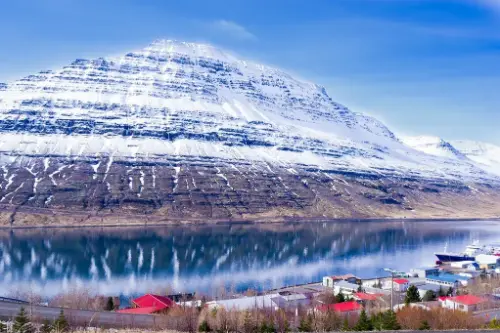 Day 8: 09:00–20:00
Eskifjordur / Iceland
Eskifjordur is a small yet picturesque fjord located in Eastern Iceland, attracting tourists with its natural beauty and peaceful atmosphere. Surrounded by high mountain ranges, Eskifjordur is an ideal destination for those seeking tranquility away from crowded tourist spots. Visitors can enjoy the fresh air and breathtaking views of the fjord, which connects to the Atlantic Ocean. Traditional Icelandic houses with turf roofs add to the charm of this peaceful town.
The town is also known for its cultural heritage and history. Nearby villages offer a glimpse into the traditional lifestyle of the locals, and several interesting museums, including a fishing museum, tell the story of the region's fishing industry. Eskifjordur is also an excellent base for exploring Eastern Iceland, with opportunities for hiking, fishing, and wildlife watching, including local birds and marine mammals.
-
 Day 9: 13:00–20:00
Husavik / Iceland
-
 Day 10: 08:00–22:00
Akureyri / Iceland
Akureyri is a town in northern Iceland. It is Iceland's Fifth largest municipality.
Nicknamed the Capital of North Iceland, Akureyri is an important port and fishing centre. The area where Akureyri is located was settled in the 9th century but did not receive a municipal charter until 1786. The town was the site of Alliedunits during World War II. Further growth occurred after the war as the Icelandic population increasingly moved to urban areas.
The area has a relatively mild climate because of geographical factors, and the town's ice-free harbour has played a significant role in its history.
-
 Day 11: 11:00–18:00
Isafjordur / Iceland
Isafjörður, meaning ice fjord or fjord of ice, ice in plural genitive) is a town in the northwest of Iceland.
The oldest part of Ísafjörður with the town centre is located on a spit of sand, or eyri, in Skutulsfjörður, a fjord which meets the waters of the larger fjord Ísafjarðardjúp. With a population of about 2,600, Ísafjörður is the largest settlement in the peninsula of Vestfirðir (Westfjords) and the administration centre of the Ísafjarðarbær municipality, which includes – besides Ísafjörður – the nearby villages of Hnífsdalur, Flateyri, Suðureyri, and Þingeyri.
-
Day 12: 08:00–22:00
Reykjanesbaer
-
 Day 13: 07:00
Reykjavik / Iceland
Reykjavík is the capital and largest city of Iceland. It is located in southwestern Iceland, on the southern shore of Faxa Bay. Its latitude is 64°08' N, making it the world's northernmost capital of a sovereign state. With a population of around 123,300 (and over 216,940 in the Capital Region), it is the heart of Iceland's cultural, economic and governmental activity, and is a popular tourist destination.
Reykjavík is believed to be the location of the first permanent settlement in Iceland, which, according to Ingólfr Arnarson, was established in AD 874. Until the 19th century, there was no urban development in the city location. The city was founded in 1786 as an official trading town and grew steadily over the following decades, as it transformed into a regional and later national centre of commerce, population, and governmental activities. It is among the cleanest, greenest, and safest cities in the world.
Please wait…
Tour operator
Biznes i Turystyka Piotr Skupiewski
- ul. Łukowa 41, 32-823 Szczepanów
- NIP 8691148381
- REGON 850455159
- +48 576 977 555
- +48 570 700 273
The tour operator is entered in the Central Register of Tour Operators and Entrepreneurs Facilitating the Purchase of Linked Travel Arrangements. It holds UNIQA insurance guarantee no. 3800003856, valid from 5 May 2026 to 4 May 2027. The guarantee sum is PLN 379,404.00. The operator pays contributions to the Tourist Guarantee Fund and the Tourist Assistance Fund.
Still have a question?
We'll help you choose a cruise and answer your questions.