

Rejs morski · 06.10.2026 – 17.11.2026 · 42 nocy
42 noce z Fusiny
Trasa i informacje o rejsie
Premium- Fusina
- Korfu
- Argostoli, Kefalonia (Wyspy Jońskie)
- Gition
- Santorini, Cyklady
- Agios Nikolaos, ks. Kreta
- Rodos
- Kusadasi (Efez)
- Patmos
- Mykonos
- Pireus (Ateny)
- Syros
- Bodrum
- Heraklion
- Aleksandria
- Aleksandria
- Valletta
- Syracuse
- Katania
- Salerno
- Salerno
- Rzym (Civitavecchia)
- Livorno
- Livorno
- Monte Carlo
- Nicea
- Marsylia
- Palamos
- Barcelona
- Walencja
- Cartagena (Bolívar)
- Malaga
- Gibraltar
- Sewilla
- Sewilla
- Sewilla
- Lizbona
- Lizbona
| Data | Port | Przypłynięcie | Wypłynięcie |
|---|---|---|---|
| 06.10.2026 |
Fusina
Włochy
|
— | 18:00 |
| 07.10.2026 |
Dzień na morzu
|
— | — |
| 08.10.2026 |
Korfu
Grecja
|
08:00 | 22:00 |
| 09.10.2026 |
Argostoli, Kefalonia (Wyspy Jońskie)
Grecja
|
08:00 | 18:00 |
| 10.10.2026 |
Gition
Grecja
|
08:00 | 18:00 |
| 11.10.2026 |
Santorini, Cyklady
Grecja
|
08:00 | 20:00 |
| 12.10.2026 |
Agios Nikolaos, ks. Kreta
Grecja
|
08:00 | 20:00 |
| 13.10.2026 |
Rodos
Grecja
|
08:00 | 21:30 |
| 14.10.2026 |
Kusadasi (Efez)
Turcja
|
09:00 | 22:00 |
| 15.10.2026 |
Patmos
Grecja
|
08:00 | 20:00 |
| 16.10.2026 |
Mykonos
Grecja
|
08:00 | 18:00 |
| 17.10.2026 |
Pireus (Ateny)
Grecja
|
05:00 | 18:00 |
| 18.10.2026 |
Syros
Grecja
|
08:00 | 18:00 |
| 19.10.2026 |
Bodrum
Turcja
|
08:00 | 20:00 |
| 20.10.2026 |
Heraklion
Grecja
|
08:00 | 22:00 |
| 21.10.2026 |
Dzień na morzu
|
— | — |
| 22.10.2026 |
Aleksandria
Egipt
|
06:00 | — |
| 23.10.2026 |
Aleksandria
Egipt
|
— | 20:00 |
| 24.10.2026 |
Dzień na morzu
|
— | — |
| 25.10.2026 |
Dzień na morzu
|
— | — |
| 26.10.2026 |
Valletta
Malta
|
08:00 | 22:00 |
| 27.10.2026 |
Syracuse
Włochy
|
08:00 | 22:00 |
| 28.10.2026 |
Katania
Włochy
|
08:00 | 16:00 |
| 29.10.2026 |
Salerno
Włochy
|
08:00 | — |
| 30.10.2026 |
Salerno
Włochy
|
— | 16:00 |
| 31.10.2026 |
Rzym (Civitavecchia)
Włochy
|
06:00 | 18:00 |
| 01.11.2026 |
Livorno
Włochy
|
08:00 | — |
| 02.11.2026 |
Livorno
Włochy
|
— | 20:00 |
| 03.11.2026 |
Monte Carlo
Monaco
|
08:00 | 22:00 |
| 04.11.2026 |
Nicea
Francja
|
08:00 | 20:00 |
| 05.11.2026 |
Marsylia
Francja
|
08:00 | 22:00 |
| 06.11.2026 |
Palamos
Hiszpania
|
08:30 | 19:00 |
| 07.11.2026 |
Barcelona
Hiszpania
|
06:00 | 18:00 |
| 08.11.2026 |
Walencja
Hiszpania
|
07:30 | 22:00 |
| 09.11.2026 |
Cartagena (Bolívar)
Kolumbia
|
11:00 | 18:00 |
| 10.11.2026 |
Malaga
Hiszpania
|
08:00 | 22:00 |
| 11.11.2026 |
Gibraltar
Wielka Brytania
|
07:30 | 18:00 |
| 12.11.2026 |
Sewilla
Hiszpania
|
11:00 | — |
| 13.11.2026 |
Sewilla
Hiszpania
|
— | — |
| 14.11.2026 |
Sewilla
Hiszpania
|
— | 21:00 |
| 15.11.2026 |
Dzień na morzu
|
— | — |
| 16.11.2026 |
Lizbona
Portugalia
|
08:00 | — |
| 17.11.2026 |
Lizbona
Portugalia
|
08:00 | — |
-
Dzień 1: 18:00
Fusina / Włochy
-
Dzień 2:
Dzień na morzu / Morze
-
 Dzień 3: 08:00–22:00
Korfu / Grecja
Korfu uchodzi za najpiękniejszą wyspę archipelagu Jońskiego. Wyspa jest niezwykle żyzna – głównymi produktami są oliwa z oliwek, owoce południowe i wino. Stara część miasta Korfu zachwyca malowniczymi uliczkami i architekturą różnych kultur europejskich. Wyspa ma bogatą historię – przez wieki przyciągała najeźdźców, a największy wpływ na jej kulturę wywarły Włochy, co łatwo wytłumaczyć bliskością tego kraju. Korfu odwiedzali m.in. Goethe i Napoleon, a cesarzowa Elżbieta Austriacka mieszkała tu przez długi czas. Klimat sprzyja turystom – nawet latem morska bryza przynosi przyjemne orzeźwienie.
-
 Dzień 4: 08:00–18:00
Argostoli, Kefalonia (Wyspy Jońskie) / Grecja
Argostoli to stolica Kefalonii, największej wyspy Archipelagu Jońskiego w Grecji. Miasto, położone na zachodnim wybrzeżu wyspy, słynie z malowniczych nadbrzeży, eleganckich kawiarni i neoklasycznych budynków. W Argostoli znajduje się także wiele historycznych zabytków, w tym Archeologiczne Muzeum Kefalonii oraz plac Valiianos, na którym można zobaczyć ślady zniszczeń pozostałe po trzęsieniu ziemi z 1953 roku, które niemal całkowicie zniszczyło miasto. Spacerując po ulicach, turyści mogą podziwiać harmonijne połączenie tradycyjnej greckiej architektury z nowoczesnością.
Miasto jest również doskonałą bazą wypadową do odkrywania naturalnych piękności Kefalonii. Zaledwie kilka kilometrów od Argostoli znajdują się znane plaże, takie jak Lourdas i Melissani, a także słynna jaskinia Dragonera, gdzie można podziwiać stalaktyty i stalagmity. Z Argostoli łatwo jest również udać się na wycieczki do unikalnych rezerwatów przyrody, takich jak rezerwat żółwi, w którym żyją rzadkie morskie żółwie Caretta caretta. Miasto to idealne miejsce do połączenia turystyki kulturalnej z odkrywaniem naturalnych cudów wyspy.
-
Dzień 5: 08:00–18:00
Gition / Grecja
-
 Dzień 6: 08:00–20:00
Santorini, Cyklady / Grecja
Grecja dzieli się z Tobą pięknem jednego z najczarowniejszych wulkanicznych archipelagów Morza Egejskiego – Santorini. Wulkan wciąż jest aktywny, ale dla turystów stworzono bezpieczne warunki, dzięki czemu można tu śmiało przyjeżdżać. To właśnie jemu zawdzięczamy czarne plaże, krajobrazy ze stwardniałej czerwono-brunatnej lawy, turkusowe widoki morza i kontrastujące z nimi bielone domki. Jeśli odwiedzisz Santorini, nie zapomnij o stanowisku archeologicznym w Akrotiri, gdzie zachowały się pozostałości minojskiej cywilizacji.
-
 Dzień 7: 08:00–20:00
Agios Nikolaos, ks. Kreta / Grecja
Agios Nikolaos or Aghios Nikolaos is a coastal town on the Greek island of Crete, lying east of the island's capital Heraklion, north of the town of Ierapetra and west of the town of Sitia.
In the year 2011, the Municipality of Agios Nikolaos, which takes in part of the surrounding villages, claimed 27,074 inhabitants. The town is a municipality of the Crete region and sits partially upon the ruins of the ancient city of Lato pros Kamara.
Agios Nikolaos was settled in the late Bronze Age by Dorian occupants of Lato, at a time when the security of the Lato hillfort became a lesser concern and easy access to the harbour at Agios Nikolaos became more important.
The name Agios Nikolaos means Saint Nicholas. Its stress lies on the second syllable of the word "Nikolaos". Agios Nikolaos or Ayios Nikolaos (alternative romanizations of the Greek Άγιος Νικόλαος) is a common placename in Greece and Cyprus, since Saint Nicholas is the patron saint of sailors and of all of Greece.
-
 Dzień 8: 08:00–21:30
Rodos / Grecja
Rhodes is the largest of the Dodecanese islands of Greece and is also the island group's historical capital. Administratively the island forms a separate municipality within the Rhodes regional unit, which is part of the South Aegean administrative region. The principal town of the island and seat of the municipality is Rhodes. The city of Rhodes had 50,636 inhabitants in 2011. It is located northeast of Crete, southeast of Athens and just off the Anatolian coast of Turkey. Rhodes' nickname is The island of the Knights, named after the Knights of Saint John of Jerusalem, who once conquered the land.
Historically, Rhodes was famous worldwide for the Colossus of Rhodes, one of the Seven Wonders of the Ancient World. The Medieval Old Town of the City of Rhodes has been declared a World Heritage Site. Today, it is one of the most popular tourist destinations in Europe. The name of the U.S. state of Rhode Island is thought to be based on this island.
-
 Dzień 9: 09:00–22:00
Kusadasi (Efez) / Turcja
Kusadasi kiedyś było małą wioską rybacką na wybrzeżu Morza Egejskiego, dziś zaś jest miastem portowym z dobrze rozwiniętą infrastrukturą. Co więcej, dzięki luksusowym hotelom, restauracjom, klubom nocnym i doskonałej obsłudze Kusadasi przekształciło się w modny turecki kurort.
Miasto otrzymało swoją nazwę, która w tłumaczeniu brzmi „Wyspa ptaków”, dzięki niewielkiej wyspie przylegającej do wybrzeża, dokąd przez wiele stuleci zlatują się gniazdować różne gatunki ptaków.
Miłośnicy spokojnej atmosfery mogą znaleźć wiele ustronnych zakątków, pospacerować uliczkami i wypocząć na piaszczystej plaży. Jasne światła nocnego miasta, liczne dyskoteki, bary i restauracje dają możliwość świetnej zabawy.
Turyści preferujący aktywne formy sportu mogą spróbować swoich sił w windsurfingu, nurkowaniu lub siatkówce plażowej.
-
 Dzień 10: 08:00–20:00
Patmos / Grecja
Patmos is a small Greek island in the Aegean Sea, most famous for being the location of the vision given to the disciple John in the Book of Revelation in the New Testament, and where the book was written.
One of the northernmost islands of the Dodecanese complex, it has a population of 2,998 and an area of 34.05 km2(13.15 sq mi). The highest point is Profitis Ilias, 269 metres (883 ft) above sea level. The municipality of Patmos, which includes the offshore islands of Arkoi (pop. 44), Marathos (pop. 5), and several uninhabited islets, has a total population of 3,047 (2011 census) and a combined land area of 45.039 square kilometres (17.390 sq mi). It is part of the Kalymnos regional unit.
Patmos' main communities are Chora (the capital city), and Skala, the only commercial port. Other settlements are Grikou and Kampos. The churches and communities on Patmos are of the Eastern Orthodox tradition. The mayor of Patmos is Gregory Stoikos.
-
 Dzień 11: 08:00–18:00
Mykonos / Grecja
Słynna, nowoczesna wyspa Mykonos przyciąga turystów swoim urokiem. Trudno oprzeć się widokowi lazurowego morza i skąpanego w słońcu białego miasta. Mykonos to wyspa kontrastów – biel domów, błękit głębin i kolorowe okna. Wśród atrakcji warto wspomnieć liczne kościoły i muzea, m.in. Muzeum Archeologiczne z amforą przedstawiającą scenę z Trojańskim koniem.
Mykonos to modny kurort i ulubione miejsce bohemy. To tutaj można zanurzyć się w wir luksusowych usług, rozrywek i nocnego życia. Ale wyspa ma także spokojniejsze oblicze – czekają na Ciebie urokliwe, ciche zakątki, idealne do relaksu i odpoczynku.
-
 Dzień 12: 05:00–18:00
Pireus (Ateny) / Grecja
Pireus to stare miasto portowe, będące portem Aten i jednocześnie największym portem Grecji w dniu dzisiejszym. Pireus stanowi część wielkich Aten, które mogą poszczycić się bogactwem atrakcji, w tym unikalnymi zabytkami narodowej sztuki plastycznej.
Ponad dwieście muzeów i galerii, w tym Muzeum Historii Uniwersytetu, Muzeum Archeologiczne Keramejkos i wiele innych, gościnnie powita Państwa w swoich murach i zapozna z kulturą tej okolicy.
-
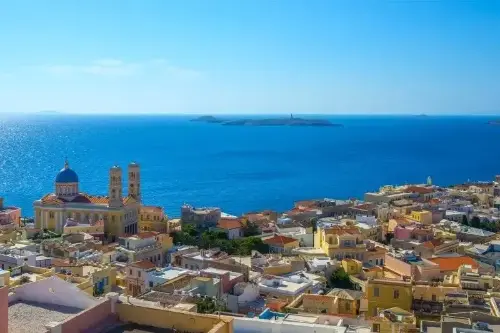 Dzień 13: 08:00–18:00
Syros / Grecja
Syros to malownicza wyspa w archipelagu Cyklad, znana z bogatej historii i zróżnicowanej architektury. Jej stolica, Ermoupoli, to jedno z nielicznych greckich miast, w których bizantyjskie kościoły sąsiadują z neoklasycznymi rezydencjami. Dawniej najważniejszy ośrodek morski Grecji, dziś nadal zachowuje elegancki i kulturowo bogaty charakter.
Wyspa idealna dla podróżnych szukających nie tylko plażowego relaksu, ale i autentycznych wrażeń. Urokliwe zatoczki, malownicze szlaki i lokalna kuchnia — od świeżych owoców morza po "lagano", tradycyjny chleb pieczony z oliwą. Ciekawostka: w Ermoupoli znajduje się jeden z najstarszych teatrów w Grecji — teatr Apollon, wzorowany na mediolańskiej La Scali.
-
 Dzień 14: 08:00–20:00
Bodrum / Turcja
Bodrum is a famous Turkish resort on the Aegean Sea, located in the province of Mugla. The city is located in the extreme southwest of the country, on the coast of ancient Caria, which today is called the Turkish Riviera. Bodrum is perhaps the most international of all cities in Turkey. It is famous for its restaurants, night clubs, the atmosphere of eternal celebration and the bohemian lifestyle. This combination is especially attractive for young people from Europe and liberated Turks who come here in the summer to swim, soak up the sun, and “hang out” in open-air pubs, discos and bars. Curious tourists in these parts are attracted by the desire to get acquainted with the millenary history of the region, to see the ancient and medieval monuments located here.
-
 Dzień 15: 08:00–22:00
Heraklion / Grecja
Heraklion or Heraclion is the largest city and the administrative capital of the island of Crete. It is the fourth largest city in Greece. According to the results of the 2011 census, the population of the city proper was 166,209 inhabitants, the municipality's was 173,993 while the Heraklion urban area has a population of 225,574 and it extends over an area of 684.3 km2 (264.2 sq mi).
Heraklion is the capital of Heraklion regional unit.
The Bronze Age palace of Knossos, also known as the Palace of Minos, is located nearby.
-
Dzień 16:
Dzień na morzu / Morze
-
 Dzień 17: 06:00
Aleksandria / Egipt
the chief port of Egypt; population 4,084,700 (est. 2006). Founded in 332 bc by Alexander the Great, it was a major center of Hellenistic culture, renowned for its library and for the Pharos lighthouse.
-
Dzień 18: 20:00
Aleksandria / Egipt
the chief port of Egypt; population 4,084,700 (est. 2006). Founded in 332 bc by Alexander the Great, it was a major center of Hellenistic culture, renowned for its library and for the Pharos lighthouse.
-
Dzień 19:
Dzień na morzu / Morze
-
Dzień 20:
Dzień na morzu / Morze
-
 Dzień 21: 08:00–22:00
Valletta / Malta
The capital of Malta - Valletta , is the first and almost the only city in Europe, which was once designed by architects and built according to all the rules and norms of construction. Valletta is considered to be one of the most beautiful cities on the Mediterranean. Klaipeda is on the list of the few remaining fortified towns. The center of the city is the Palace of the Grand Master of the Order of Malta, and today the residence of the President of the country, here is the seat of the Maltese Parliament. The list of places to visit in Valletta includes the Castilla Palace, the Admiralty (where the National Museum of Fine Arts is now located, with the largest painting collection in the country), a charming place in the city - the beautiful Hastings Gardens, and this is not the whole list of the riches of the capital of Malta .
-
 Dzień 22: 08:00–22:00
Syracuse / Włochy
-
 Dzień 23: 08:00–16:00
Katania / Włochy
-
 Dzień 24: 08:00
Salerno / Włochy
Salerno is one of the most popular seaside cities in Italy, intended for recreation at sea. The climate here is warm and mild, which is typical for all cities of the Neapolitan Riviera. Tourism in Salerno is at a high level, as the city is a rich historical and cultural center. Salerno contains many attractions interesting for lovers of history, art and culture.
-
Dzień 25: 16:00
Salerno / Włochy
Salerno is one of the most popular seaside cities in Italy, intended for recreation at sea. The climate here is warm and mild, which is typical for all cities of the Neapolitan Riviera. Tourism in Salerno is at a high level, as the city is a rich historical and cultural center. Salerno contains many attractions interesting for lovers of history, art and culture.
-
 Dzień 26: 06:00–18:00
Rzym (Civitavecchia) / Włochy
Rzym – jedno z najstarszych miast świata, niegdyś stolica Cesarstwa Rzymskiego, dziś stolica Włoch. Położony na siedmiu wzgórzach nad Tybrem, zachwyca pięknem i majestatem, którego nie da się oddać słowami – trzeba tu być. Każda rzeźba, fontanna czy budowla to dzieło sztuki pozostawione przez dawnych mistrzów. Najsłynniejsze atrakcje, które przyciągają turystów, to Koloseum – miejsce dawnych walk gladiatorów, Fontanna di Trevi, Schody Hiszpańskie, Bazylika św. Piotra – największy kościół Europy, a także Fora Cesarskie i Forum Romanum.
-
 Dzień 27: 08:00
Livorno / Włochy
Livorno is a port city on the Ligurian Sea on the western coast of Tuscany, Italy. It is the capital of the Province of Livorno, having a population of 158,493 residents in December 2017. It has traditionally been known in English as Leghorn.
The origins of Livorno are controversial, although the place was inhabited since the Neolithic Age as shown by worked bones, pieces of copper and ceramic found on the Livorno Hills in a cave between Ardenza and Montenero. The construction of the Via Aurelia coincided with the occupation of the region by the Romans, who left traces of their presence in the toponyms and ruins of towers. The natural cove called Liburna, later transformed into Livorna, before becoming Livorno, is a reference to the type of ship, the liburna, used by Roman navy. Others ancient toponyms include: Salviano (Salvius), Antignano (Ante ignem) which was the place situated before Ardenza (Ardentia) where were the beacons for the ships directed to Porto Pisano.
The name Livorna is mentioned for the first time in 1017 as a small coastal village, the port and the remains of a Roman tower. In 1077, a tower was built by Matilda of Tuscany. The Republic of Pisa owned Livorno from 1103 and built a quadrangular Fort called Quadratura dei Pisani ("Quarter of the Pisans") to defend the port. Porto Pisano was destroyed after the crushing defeat of the Pisan fleet in the Battle of Meloria in 1284. In 1399, Pisa sold Livorno to the Visconti of Milan, in 1405 it was sold to the Republic of Genoa and on 28 August 1421 it was bought by the Republic of Florence.
Between 1427 and 1429, a census counted 118 families in Livorno, including 423 persons. Monks, Jews, military personnel, and the homeless were not included in the census. The only remainder of medieval Livorno is a fragment of two towers and a wall, located inside the Fortezza Vecchia.
-
Dzień 28: 20:00
Livorno / Włochy
Livorno is a port city on the Ligurian Sea on the western coast of Tuscany, Italy. It is the capital of the Province of Livorno, having a population of 158,493 residents in December 2017. It has traditionally been known in English as Leghorn.
The origins of Livorno are controversial, although the place was inhabited since the Neolithic Age as shown by worked bones, pieces of copper and ceramic found on the Livorno Hills in a cave between Ardenza and Montenero. The construction of the Via Aurelia coincided with the occupation of the region by the Romans, who left traces of their presence in the toponyms and ruins of towers. The natural cove called Liburna, later transformed into Livorna, before becoming Livorno, is a reference to the type of ship, the liburna, used by Roman navy. Others ancient toponyms include: Salviano (Salvius), Antignano (Ante ignem) which was the place situated before Ardenza (Ardentia) where were the beacons for the ships directed to Porto Pisano.
The name Livorna is mentioned for the first time in 1017 as a small coastal village, the port and the remains of a Roman tower. In 1077, a tower was built by Matilda of Tuscany. The Republic of Pisa owned Livorno from 1103 and built a quadrangular Fort called Quadratura dei Pisani ("Quarter of the Pisans") to defend the port. Porto Pisano was destroyed after the crushing defeat of the Pisan fleet in the Battle of Meloria in 1284. In 1399, Pisa sold Livorno to the Visconti of Milan, in 1405 it was sold to the Republic of Genoa and on 28 August 1421 it was bought by the Republic of Florence.
Between 1427 and 1429, a census counted 118 families in Livorno, including 423 persons. Monks, Jews, military personnel, and the homeless were not included in the census. The only remainder of medieval Livorno is a fragment of two towers and a wall, located inside the Fortezza Vecchia.
-
 Dzień 29: 08:00–22:00
Monte Carlo / Monaco
Monte Carlo officially refers to an administrative area of the Principality of Monaco, specifically the ward of Monte Carlo/Spélugues, where the Monte Carlo Casino is located. Informally the name also refers to a larger district, the Monte Carlo Quarter (corresponding to the former municipality of Monte Carlo), which besides Monte Carlo/Spélugues also includes the wards of La Rousse/Saint Roman, Larvotto/Bas Moulins, and Saint Michel. The permanent population of the ward of Monte Carlo is about 3,500, while that of the quarter is about 15,000. Monaco has four traditional quarters. From west to east they are: Fontvieille (the newest), Monaco-Ville (the oldest), La Condamine, and Monte Carlo.
Monte Carlo (literally "Mount Charles") is situated on a prominent escarpment at the base of the Maritime Alpsalong the French Riviera. Near the quarter's western end is the world-famous Place du Casino, the gamblingcenter which has made Monte Carlo "an international byword for the extravagant display and reckless dispersal of wealth". It is also the location of the Hôtel de Paris, the Café de Paris, and the Salle Garnier (the casino theatre which is the home of the Opéra de Monte-Carlo).
The quarter's eastern part includes the community of Larvotto with Monaco's only public beach, as well as its new convention center (the Grimaldi Forum), and the Monte-Carlo Bay Hotel & Resort. At the quarter's eastern border, one crosses into the French town of Beausoleil (sometimes referred to as Monte-Carlo-Supérieur), and just 8 kilometres (5 mi) to its east is the western border of Italy.
-
 Dzień 30: 08:00–20:00
Nicea / Francja
Nice is the seventh most populous urban area in France and the capital of the Alpes-Maritimes département. The metropolitan area of Nice extends beyond the administrative city limits, with a population of about 1 million on an area of 721 km2 (278 sq mi). Located in the French Riviera, on the south east coast of France on the Mediterranean Sea, at the foot of the Alps, Nice is the second-largest French city on the Mediterranean coast and the second-largest city in the Provence-Alpes-Côte d'Azur region after Marseille. Nice is approximately 13 kilometres (8.1 mi) from the principality of Monaco and 30 kilometres (19 mi) from the French-Italian border. Nice's airport serves as a gateway to the region.
The city is nicknamed Nice la Belle (Nissa La Bella in Niçard), which means Nice the Beautiful, which is also the title of the unofficial anthem of Nice, written by Menica Rondelly in 1912.
The area of today's Nice contains Terra Amata, an archaeological site which displays evidence of a very early use of fire. Around 350 BC, Greeks of Marseille founded a permanent settlement and called it Nikaia, after Nike, the goddess of victory. Through the ages, the town has changed hands many times. Its strategic location and port significantly contributed to its maritime strength. For centuries it was a dominion of Savoy, and was then part of France between 1792 and 1815, when it was returned to Piedmont-Sardinia until its re-annexation by France in 1860.
The natural environment of the Nice area and its mild Mediterranean climate came to the attention of the English upper classes in the second half of the 18th century, when an increasing number of aristocratic families took to spending their winters there. The city's main seaside promenade, the Promenade des Anglais ("Walkway of the English") owes its name to visitors to the resort. The clear air and soft light have particularly appealed to notable painters, such as Marc Chagall, Henri Matisse, Niki de Saint Phalle and Arman. Their work is commemorated in many of the city's museums, including Musée Marc Chagall, Musée Matisse and Musée des Beaux-Arts. Nice has the second largest hotel capacity in the country and it is one of its most visited cities, receiving 4 million tourists every year. It also has the third busiest airport in France, after the two main Parisian ones. It is the historical capital city of the County of Nice(Comté de Nice).
Nice is the seventh most populous urban area in France and the capital of the Alpes-Maritimes département. The metropolitan area of Nice extends beyond the administrative city limits, with a population of about 1 million on an area of 721 km2 (278 sq mi). Located in the French Riviera, on the south east coast of France on the Mediterranean Sea, at the foot of the Alps, Nice is the second-largest French city on the Mediterranean coast and the second-largest city in the Provence-Alpes-Côte d'Azur region after Marseille. Nice is approximately 13 kilometres (8.1 mi) from the principality of Monaco and 30 kilometres (19 mi) from the French-Italian border. Nice's airport serves as a gateway to the region.The city is nicknamed Nice la Belle (Nissa La Bella in Niçard), which means Nice the Beautiful, which is also the title of the unofficial anthem of Nice, written by Menica Rondelly in 1912.
The area of today's Nice contains Terra Amata, an archaeological site which displays evidence of a very early use of fire. Around 350 BC, Greeks of Marseille founded a permanent settlement and called it Nikaia, after Nike, the goddess of victory. Through the ages, the town has changed hands many times. Its strategic location and port significantly contributed to its maritime strength. For centuries it was a dominion of Savoy, and was then part of France between 1792 and 1815, when it was returned to Piedmont-Sardinia until its re-annexation by France in 1860.
The natural environment of the Nice area and its mild Mediterranean climate came to the attention of the English upper classes in the second half of the 18th century, when an increasing number of aristocratic families took to spending their winters there. The city's main seaside promenade, the Promenade des Anglais ("Walkway of the English") owes its name to visitors to the resort. The clear air and soft light have particularly appealed to notable painters, such as Marc Chagall, Henri Matisse, Niki de Saint Phalle and Arman. Their work is commemorated in many of the city's museums, including Musée Marc Chagall, Musée Matisse and Musée des Beaux-Arts. Nice has the second largest hotel capacity in the country and it is one of its most visited cities, receiving 4 million tourists every year. It also has the third busiest airport in France, after the two main Parisian ones. It is the historical capital city of the County of Nice(Comté de Nice).
-
 Dzień 31: 08:00–22:00
Marsylia / Francja
Witamy w gościnnym Prowansie! Bramą do tego regionu jest Marsylia – miasto „Marsylianki”, hymnu Francji, oraz słynnego Zamku If. Symbolem Marsylii jest bazylika Notre-Dame de la Garde. Latem można wziąć udział w oprowadzaniu po francusku (3 EUR), a dopłacając 5 EUR wejść na dach, skąd rozciąga się wspaniała panorama miasta. W pobliżu znajduje się opactwo św. Wiktora z ciekawymi katakumbami.
Rejs turystycznym statkiem na Wyspy Frioul pozwala zobaczyć Zamek If – znany z powieści o hrabim Monte Christo. Kulturalnym sercem Marsylii są Cours Julien i plac Jeana Jaurèsa – pełne księgarni, alternatywnych sklepów, klubów i kawiarni. Dwa razy w tygodniu odbywa się tu wielki targ (czwartek i sobota). Wśród atrakcji miasta znajdują się liczne muzea, galerie i dzieła architektury, a także malownicze zatoki zwane kalankami, uznawane za francuskie fiordy.
-
 Dzień 32: 08:30–19:00
Palamos / Hiszpania
-
 Dzień 33: 06:00–18:00
Barcelona / Hiszpania
Mając reputację jednego z najatrakcyjniejszych miast w Europie, Barcelona świętuje swoją rolę stolicy Katalonii. Kosmopolityczna i międzynarodowa atmosfera miasta sprawia, że jest to ulubione miejsce wielu ludzi na całym świecie. Miasto jest szczególnie znane ze swojej architektury i sztuki – podróżnicy z całego świata przybywają, aby zobaczyć słynną Sagrada Familia i inne modernistyczne zabytki zaprojektowane przez Gaudiego.
Barcelona to miasto z licznymi i oryginalnymi możliwościami spędzania czasu wolnego, które sprawiają, że chcesz tu wracać. Położona na wybrzeżu Morza Śródziemnego Barcelona słynie z arcydzieł Gaudiego i architektury secesyjnej: jest jednym z najbardziej stylowych miast europejskich.
Miasto jest ośrodkiem nowych trendów w świecie kultury, mody i gastronomii. Dopełnieniem kreatywności artystów i projektantów jest ostrożne podejście do tradycyjnych placówek. Barcelona łączy w sobie urok i spokój historycznego centrum z awangardowymi nowoczesnymi dzielnicami i intensywnym tempem życia w jednym z najczęściej odwiedzanych miast na świecie.
-
 Dzień 34: 07:30–22:00
Walencja / Hiszpania
-
 Dzień 35: 11:00–18:00
Cartagena (Bolívar) / Kolumbia
Starożytne mury forteczne, uliczni muzycy i karaibskie słońce tworzą niepowtarzalną atmosferę w Cartagenie (Bolívar) – perle kolumbijskiego wybrzeża. Miasto wpisane na listę światowego dziedzictwa UNESCO zachwyca kolonialną architekturą, uroczymi dziedzińcami i aromatem świeżo parzonej kawy z licznych kawiarni.
Zanurz się w tętniący życiem rytm Cartageny, spacerując brukowanymi uliczkami Starego Miasta, gdzie każdy zakątek kryje opowieści o piratach i hiszpańskich konkwistadorach. Zachód słońca przy starożytnej twierdzy Castillo San Felipe de Barajas to idealne zakończenie dnia pełnego kultury, historii i tropikalnego uroku.
-
 Dzień 36: 08:00–22:00
Malaga / Hiszpania
Málaga is a municipality, capital of the Province of Málaga, in the Autonomous Community of Andalusia, Spain. With a population of 569,130 in 2015, it is the second-most populous city of Andalusia and the sixth-largest in Spain. The southernmost large city in Europe, it lies on the Costa del Sol (Coast of the Sun) of the Mediterranean, about 100 kilometres (62.14 miles) east of the Strait of Gibraltar and about 130 km (80.78 mi) north of Africa.
Málaga's history spans about 2,800 years, making it one of the oldest cities in the world. According to most scholars, it was founded about 770 BC by the Phoenicians as Malaka From the 6th century BC the city was under the hegemony of Ancient Carthage, and from 218 BC, it was ruled by the Roman Republic and then empire as Malaca (Latin). After the fall of the empire and the end of Visigothic rule, it was under Islamic rule as Mālaqah for 800 years, but in 1487, the Crown of Castille gained control after the Reconquista. The archaeological remains and monuments from the Phoenician, Roman, Arabic and Christian eras make the historic center of the city an "open museum", displaying its history of nearly 3,000 years.
This important cultural infrastructure and the artistic heritage have culminated in the nomination of Málaga as a candidate for the 2016 European Capital of Culture.
The painter and sculptor Pablo Picasso, Hebrew poet and Jewish philosopher Solomon Ibn Gabirol and the actor Antonio Banderas were born in Málaga. The magnum opus of Cuban composer Ernesto Lecuona, "Malagueña", is named after the music of this region of Spain.
The most important business sectors in Málaga are tourism, construction and technology services, but other sectors such as transportation and logistics are beginning to expand. The Andalusia Technology Park (PTA), located in Málaga, has enjoyed significant growth since its inauguration in 1992. Málaga is the main economic and financial centre of southern Spain, home of the region's largest bank, Unicaja, and the fourth-ranking city in economic activity in Spain behind Madrid, Barcelona and Valencia.
-
 Dzień 37: 07:30–18:00
Gibraltar / Wielka Brytania
Gibraltar is a British Overseas Territory located at the southern tip of the Iberian Peninsula. It has an area of 6.7 km2 (2.6 sq mi) and is bordered to the north by Spain. The landscape is dominated by the Rock of Gibraltar at the foot of which is a densely populated town area, home to over 30,000 people, primarily Gibraltarians. It shares a maritime border with Morocco.
In 1704, Anglo-Dutch forces captured Gibraltar from Spain during the War of the Spanish Succession on behalf of the Habsburg claim to the Spanish throne. The territory was ceded to Great Britain in perpetuity under the Treaty of Utrechtin 1713. During World War II it was an important base for the Royal Navy as it controlled the entrance and exit to the Mediterranean Sea, which is only 8 miles (13 km) wide at this naval choke point. It remains strategically important, with half the world's seaborne trade passing through the strait. Today Gibraltar's economy is based largely on tourism, online gambling, financial services and cargo ship refuelling.
The sovereignty of Gibraltar is a point of contention in Anglo-Spanish relations because Spain asserts a claim to the territory. Gibraltarians rejected proposals for Spanish sovereignty in a 1967 referendum and, in a 2002 referendum, the idea of shared sovereignty was also rejected.
-
 Dzień 38: 11:00
Sewilla / Hiszpania
Sewilla jest stolicą i największym miastem autonomicznej wspólnoty Andaluzji oraz prowincji Sewilla w Hiszpanii. Położona jest na równinie rzeki Gwadalkiwir. Mieszkańców miasta nazywa się sevillanos (forma żeńska: sevillanas) lub hispalenses, od rzymskiej nazwy miasta, Hispalis. Sewilla liczy około 690 000 mieszkańców (dane z 2016 roku), a jej obszar metropolitalny około 1,5 miliona, co czyni ją czwartym co do wielkości miastem w Hiszpanii i 30. najbardziej zaludnioną gminą w Unii Europejskiej. Jej Stare Miasto o powierzchni 4 kilometrów kwadratowych (2 mile kwadratowe) zawiera trzy obiekty światowego dziedzictwa UNESCO: zespół pałacowy Alcázar, Katedrę i Archiwum Indii. Port w Sewilli, położony około 80 kilometrów (50 mil) od Oceanu Atlantyckiego, jest jedynym portem rzecznym w Hiszpanii.
-
Dzień 39:
Sewilla / Hiszpania
Sewilla jest stolicą i największym miastem autonomicznej wspólnoty Andaluzji oraz prowincji Sewilla w Hiszpanii. Położona jest na równinie rzeki Gwadalkiwir. Mieszkańców miasta nazywa się sevillanos (forma żeńska: sevillanas) lub hispalenses, od rzymskiej nazwy miasta, Hispalis. Sewilla liczy około 690 000 mieszkańców (dane z 2016 roku), a jej obszar metropolitalny około 1,5 miliona, co czyni ją czwartym co do wielkości miastem w Hiszpanii i 30. najbardziej zaludnioną gminą w Unii Europejskiej. Jej Stare Miasto o powierzchni 4 kilometrów kwadratowych (2 mile kwadratowe) zawiera trzy obiekty światowego dziedzictwa UNESCO: zespół pałacowy Alcázar, Katedrę i Archiwum Indii. Port w Sewilli, położony około 80 kilometrów (50 mil) od Oceanu Atlantyckiego, jest jedynym portem rzecznym w Hiszpanii.
-
Dzień 40: 21:00
Sewilla / Hiszpania
Sewilla jest stolicą i największym miastem autonomicznej wspólnoty Andaluzji oraz prowincji Sewilla w Hiszpanii. Położona jest na równinie rzeki Gwadalkiwir. Mieszkańców miasta nazywa się sevillanos (forma żeńska: sevillanas) lub hispalenses, od rzymskiej nazwy miasta, Hispalis. Sewilla liczy około 690 000 mieszkańców (dane z 2016 roku), a jej obszar metropolitalny około 1,5 miliona, co czyni ją czwartym co do wielkości miastem w Hiszpanii i 30. najbardziej zaludnioną gminą w Unii Europejskiej. Jej Stare Miasto o powierzchni 4 kilometrów kwadratowych (2 mile kwadratowe) zawiera trzy obiekty światowego dziedzictwa UNESCO: zespół pałacowy Alcázar, Katedrę i Archiwum Indii. Port w Sewilli, położony około 80 kilometrów (50 mil) od Oceanu Atlantyckiego, jest jedynym portem rzecznym w Hiszpanii.
-
Dzień 41:
Dzień na morzu / Morze
-
 Dzień 42: 08:00
Lizbona / Portugalia
Lizbona jest stolicą i największym miastem Portugalii, z szacowaną populacją 505 526 mieszkańców w granicach administracyjnych na obszarze 100,05 km². Jej obszar miejski rozciąga się poza granice administracyjne miasta i liczy około 2,8 miliona mieszkańców, co czyni go jedenastym najbardziej zaludnionym obszarem miejskim w Unii Europejskiej. Około 3 milionów ludzi mieszka w aglomeracji lizbońskiej (która stanowi około 27% populacji kraju). Jest to najbardziej wysunięta na zachód stolica kontynentalnej Europy i jedyna położona nad Oceanem Atlantyckim. Lizbona leży na zachodnim Półwyspie Iberyjskim nad Oceanem Atlantyckim i rzeką Tag. Najbardziej wysunięte na zachód obszary jej aglomeracji tworzą najbardziej wysunięty na zachód punkt kontynentalnej Europy, znany jako Cabo da Roca, położony w górach Sintra.
-
Dzień 43: 08:00
Lizbona / Portugalia
Lizbona jest stolicą i największym miastem Portugalii, z szacowaną populacją 505 526 mieszkańców w granicach administracyjnych na obszarze 100,05 km². Jej obszar miejski rozciąga się poza granice administracyjne miasta i liczy około 2,8 miliona mieszkańców, co czyni go jedenastym najbardziej zaludnionym obszarem miejskim w Unii Europejskiej. Około 3 milionów ludzi mieszka w aglomeracji lizbońskiej (która stanowi około 27% populacji kraju). Jest to najbardziej wysunięta na zachód stolica kontynentalnej Europy i jedyna położona nad Oceanem Atlantyckim. Lizbona leży na zachodnim Półwyspie Iberyjskim nad Oceanem Atlantyckim i rzeką Tag. Najbardziej wysunięte na zachód obszary jej aglomeracji tworzą najbardziej wysunięty na zachód punkt kontynentalnej Europy, znany jako Cabo da Roca, położony w górach Sintra.
Organizator
Biznes i Turystyka Piotr Skupiewski
- ul. Łukowa 41, 32-823 Szczepanów
- NIP 8691148381
- REGON 850455159
- +48 576 977 555
- +48 570 700 273
Organizator jest wpisany do Centralnej Ewidencji Organizatorów Turystyki i Przedsiębiorców Ułatwiających Nabywanie Powiązanych Usług Turystycznych. Posiada gwarancję ubezpieczeniową UNIQA nr 3800003856, ważną od 5 maja 2026 r. do 4 maja 2027 r. Suma gwarancyjna wynosi 379 404,00 zł. Organizator odprowadza składki do Turystycznego Funduszu Gwarancyjnego i Turystycznego Funduszu Pomocowego.
Częste pytania
Rekomendujemy przylot dzień przed rozpoczęciem rejsu.
- W porcie należy stawić się 2–3 godziny przed wypłynięciem.
- Zamawiając transfer lotnisko–port, zaplanuj co najmniej 5 godzin między lądowaniem a planowanym wypłynięciem.
Masz jeszcze pytania?
Pomożemy wybrać rejs i odpowiemy na Twoje pytania.