

Rejs morski · 16.06.2026 – 20.07.2026 · 34 nocy
34 noce z Barcelony
Trasa i informacje o rejsie
Premium- Barcelona
- Walencja
- Palma de Mallorca
- Cartagena (Bolívar)
- Malaga
- Gibraltar
- Sewilla
- Sewilla
- Sewilla
- Lizbona
- Lizbona
- Porto
- Ferrol
- Saint-Malo
- Honfleur
- Дувр
- Bruges
- Amsterdam
- Hamburg
- Hamburg
- Kanał Kiloński
- Fredericia
- Kopenhaga
- Gdańsk
- Gdańsk
- Kłajpeda (Memel)
- Ryga
- Tallinn
- Helsinki
- Turku
- Mariehamn, Wyspy Alandzkie
- Sztokholm
- Sztokholm
| Data | Port | Przypłynięcie | Wypłynięcie |
|---|---|---|---|
| 16.06.2026 |
Barcelona
Hiszpania
|
— | 18:00 |
| 17.06.2026 |
Walencja
Hiszpania
|
07:30 | 22:00 |
| 18.06.2026 |
Palma de Mallorca
Hiszpania
|
09:00 | 18:00 |
| 19.06.2026 |
Cartagena (Bolívar)
Kolumbia
|
08:00 | 18:00 |
| 20.06.2026 |
Malaga
Hiszpania
|
07:30 | 22:00 |
| 21.06.2026 |
Gibraltar
Wielka Brytania
|
08:00 | 20:00 |
| 22.06.2026 |
Sewilla
Hiszpania
|
13:30 | — |
| 23.06.2026 |
Sewilla
Hiszpania
|
— | — |
| 24.06.2026 |
Sewilla
Hiszpania
|
— | 02:30 |
| 25.06.2026 |
Lizbona
Portugalia
|
08:00 | — |
| 26.06.2026 |
Lizbona
Portugalia
|
07:00 | 18:00 |
| 27.06.2026 |
Porto
Portugalia
|
08:00 | 18:00 |
| 28.06.2026 |
Ferrol
Hiszpania
|
11:00 | 20:00 |
| 29.06.2026 |
Dzień na morzu
|
— | — |
| 30.06.2026 |
Saint-Malo
Francja
|
07:30 | 18:00 |
| 01.07.2026 |
Honfleur
Francja
|
07:30 | 18:00 |
| 02.07.2026 |
Дувр
Wielka Brytania
|
08:00 | 22:00 |
| 03.07.2026 |
Bruges
Belgia
|
08:00 | 20:00 |
| 04.07.2026 |
Amsterdam
Holandia
|
08:00 | 17:00 |
| 05.07.2026 |
Hamburg
Niemcy
|
13:30 | — |
| 06.07.2026 |
Hamburg
Niemcy
|
— | 20:00 |
| 07.07.2026 |
Kanał Kiloński
Niemcy
|
06:00 | 18:00 |
| 08.07.2026 |
Fredericia
Denmark
|
08:00 | 18:00 |
| 09.07.2026 |
Kopenhaga
Denmark
|
06:00 | 17:00 |
| 10.07.2026 |
Gdańsk
Polska
|
14:00 | — |
| 11.07.2026 |
Gdańsk
Polska
|
— | 20:00 |
| 12.07.2026 |
Kłajpeda (Memel)
Litwa
|
07:30 | 14:00 |
| 13.07.2026 |
Ryga
Łotwa
|
08:00 | 22:00 |
| 14.07.2026 |
Dzień na morzu
|
— | — |
| 15.07.2026 |
Tallinn
Estonia
|
08:00 | 22:00 |
| 16.07.2026 |
Helsinki
Finland
|
08:00 | 22:00 |
| 17.07.2026 |
Turku
Finland
|
08:00 | 21:00 |
| 18.07.2026 |
Mariehamn, Wyspy Alandzkie
Finland
|
09:00 | 17:00 |
| 19.07.2026 |
Sztokholm
Sweden
|
08:00 | — |
| 20.07.2026 |
Sztokholm
Sweden
|
08:00 | — |
-
 Dzień 1: 18:00
Barcelona / Hiszpania
Mając reputację jednego z najatrakcyjniejszych miast w Europie, Barcelona świętuje swoją rolę stolicy Katalonii. Kosmopolityczna i międzynarodowa atmosfera miasta sprawia, że jest to ulubione miejsce wielu ludzi na całym świecie. Miasto jest szczególnie znane ze swojej architektury i sztuki – podróżnicy z całego świata przybywają, aby zobaczyć słynną Sagrada Familia i inne modernistyczne zabytki zaprojektowane przez Gaudiego.
Barcelona to miasto z licznymi i oryginalnymi możliwościami spędzania czasu wolnego, które sprawiają, że chcesz tu wracać. Położona na wybrzeżu Morza Śródziemnego Barcelona słynie z arcydzieł Gaudiego i architektury secesyjnej: jest jednym z najbardziej stylowych miast europejskich.
Miasto jest ośrodkiem nowych trendów w świecie kultury, mody i gastronomii. Dopełnieniem kreatywności artystów i projektantów jest ostrożne podejście do tradycyjnych placówek. Barcelona łączy w sobie urok i spokój historycznego centrum z awangardowymi nowoczesnymi dzielnicami i intensywnym tempem życia w jednym z najczęściej odwiedzanych miast na świecie.
-
 Dzień 2: 07:30–22:00
Walencja / Hiszpania
-
 Dzień 3: 09:00–18:00
Palma de Mallorca / Hiszpania
Mallorca is the largest island in the Balearic Islands, which are part of Spain and located in the Mediterranean. The native language, as on the rest of the Balearic Islands, is Catalan, which is co-official with Spanish.
The capital of the island, Palma, is also the capital of the autonomous community of the Balearic Islands. The Balearic Islands have been an autonomous region of Spain since 1983. There are two small islands off the coast of Mallorca: Cabrera (southeast of Palma) and Dragonera (west of Palma). The anthem of Mallorca is "La Balanguera".
Like the other Balearic Islands of Menorca, Ibiza and Formentera, the island is an extremely popular holiday destination, particularly for tourists from Germany and the United Kingdom. The international airport, Palma de Mallorca Airport, is one of the busiest in Spain; it was used by 28.0 million passengers in 2017, increasing every year since 2012.
The name derives from Classical Latin insula maior, "larger island". Later, in Medieval Latin, this became Maiorica, "the larger one", in comparison to Menorca, "the smaller one".
-
 Dzień 4: 08:00–18:00
Cartagena (Bolívar) / Kolumbia
Starożytne mury forteczne, uliczni muzycy i karaibskie słońce tworzą niepowtarzalną atmosferę w Cartagenie (Bolívar) – perle kolumbijskiego wybrzeża. Miasto wpisane na listę światowego dziedzictwa UNESCO zachwyca kolonialną architekturą, uroczymi dziedzińcami i aromatem świeżo parzonej kawy z licznych kawiarni.
Zanurz się w tętniący życiem rytm Cartageny, spacerując brukowanymi uliczkami Starego Miasta, gdzie każdy zakątek kryje opowieści o piratach i hiszpańskich konkwistadorach. Zachód słońca przy starożytnej twierdzy Castillo San Felipe de Barajas to idealne zakończenie dnia pełnego kultury, historii i tropikalnego uroku.
-
 Dzień 5: 07:30–22:00
Malaga / Hiszpania
Málaga is a municipality, capital of the Province of Málaga, in the Autonomous Community of Andalusia, Spain. With a population of 569,130 in 2015, it is the second-most populous city of Andalusia and the sixth-largest in Spain. The southernmost large city in Europe, it lies on the Costa del Sol (Coast of the Sun) of the Mediterranean, about 100 kilometres (62.14 miles) east of the Strait of Gibraltar and about 130 km (80.78 mi) north of Africa.
Málaga's history spans about 2,800 years, making it one of the oldest cities in the world. According to most scholars, it was founded about 770 BC by the Phoenicians as Malaka From the 6th century BC the city was under the hegemony of Ancient Carthage, and from 218 BC, it was ruled by the Roman Republic and then empire as Malaca (Latin). After the fall of the empire and the end of Visigothic rule, it was under Islamic rule as Mālaqah for 800 years, but in 1487, the Crown of Castille gained control after the Reconquista. The archaeological remains and monuments from the Phoenician, Roman, Arabic and Christian eras make the historic center of the city an "open museum", displaying its history of nearly 3,000 years.
This important cultural infrastructure and the artistic heritage have culminated in the nomination of Málaga as a candidate for the 2016 European Capital of Culture.
The painter and sculptor Pablo Picasso, Hebrew poet and Jewish philosopher Solomon Ibn Gabirol and the actor Antonio Banderas were born in Málaga. The magnum opus of Cuban composer Ernesto Lecuona, "Malagueña", is named after the music of this region of Spain.
The most important business sectors in Málaga are tourism, construction and technology services, but other sectors such as transportation and logistics are beginning to expand. The Andalusia Technology Park (PTA), located in Málaga, has enjoyed significant growth since its inauguration in 1992. Málaga is the main economic and financial centre of southern Spain, home of the region's largest bank, Unicaja, and the fourth-ranking city in economic activity in Spain behind Madrid, Barcelona and Valencia.
-
 Dzień 6: 08:00–20:00
Gibraltar / Wielka Brytania
Gibraltar is a British Overseas Territory located at the southern tip of the Iberian Peninsula. It has an area of 6.7 km2 (2.6 sq mi) and is bordered to the north by Spain. The landscape is dominated by the Rock of Gibraltar at the foot of which is a densely populated town area, home to over 30,000 people, primarily Gibraltarians. It shares a maritime border with Morocco.
In 1704, Anglo-Dutch forces captured Gibraltar from Spain during the War of the Spanish Succession on behalf of the Habsburg claim to the Spanish throne. The territory was ceded to Great Britain in perpetuity under the Treaty of Utrechtin 1713. During World War II it was an important base for the Royal Navy as it controlled the entrance and exit to the Mediterranean Sea, which is only 8 miles (13 km) wide at this naval choke point. It remains strategically important, with half the world's seaborne trade passing through the strait. Today Gibraltar's economy is based largely on tourism, online gambling, financial services and cargo ship refuelling.
The sovereignty of Gibraltar is a point of contention in Anglo-Spanish relations because Spain asserts a claim to the territory. Gibraltarians rejected proposals for Spanish sovereignty in a 1967 referendum and, in a 2002 referendum, the idea of shared sovereignty was also rejected.
-
 Dzień 7: 13:30
Sewilla / Hiszpania
Sewilla jest stolicą i największym miastem autonomicznej wspólnoty Andaluzji oraz prowincji Sewilla w Hiszpanii. Położona jest na równinie rzeki Gwadalkiwir. Mieszkańców miasta nazywa się sevillanos (forma żeńska: sevillanas) lub hispalenses, od rzymskiej nazwy miasta, Hispalis. Sewilla liczy około 690 000 mieszkańców (dane z 2016 roku), a jej obszar metropolitalny około 1,5 miliona, co czyni ją czwartym co do wielkości miastem w Hiszpanii i 30. najbardziej zaludnioną gminą w Unii Europejskiej. Jej Stare Miasto o powierzchni 4 kilometrów kwadratowych (2 mile kwadratowe) zawiera trzy obiekty światowego dziedzictwa UNESCO: zespół pałacowy Alcázar, Katedrę i Archiwum Indii. Port w Sewilli, położony około 80 kilometrów (50 mil) od Oceanu Atlantyckiego, jest jedynym portem rzecznym w Hiszpanii.
-
Dzień 8:
Sewilla / Hiszpania
Sewilla jest stolicą i największym miastem autonomicznej wspólnoty Andaluzji oraz prowincji Sewilla w Hiszpanii. Położona jest na równinie rzeki Gwadalkiwir. Mieszkańców miasta nazywa się sevillanos (forma żeńska: sevillanas) lub hispalenses, od rzymskiej nazwy miasta, Hispalis. Sewilla liczy około 690 000 mieszkańców (dane z 2016 roku), a jej obszar metropolitalny około 1,5 miliona, co czyni ją czwartym co do wielkości miastem w Hiszpanii i 30. najbardziej zaludnioną gminą w Unii Europejskiej. Jej Stare Miasto o powierzchni 4 kilometrów kwadratowych (2 mile kwadratowe) zawiera trzy obiekty światowego dziedzictwa UNESCO: zespół pałacowy Alcázar, Katedrę i Archiwum Indii. Port w Sewilli, położony około 80 kilometrów (50 mil) od Oceanu Atlantyckiego, jest jedynym portem rzecznym w Hiszpanii.
-
Dzień 9: 02:30
Sewilla / Hiszpania
Sewilla jest stolicą i największym miastem autonomicznej wspólnoty Andaluzji oraz prowincji Sewilla w Hiszpanii. Położona jest na równinie rzeki Gwadalkiwir. Mieszkańców miasta nazywa się sevillanos (forma żeńska: sevillanas) lub hispalenses, od rzymskiej nazwy miasta, Hispalis. Sewilla liczy około 690 000 mieszkańców (dane z 2016 roku), a jej obszar metropolitalny około 1,5 miliona, co czyni ją czwartym co do wielkości miastem w Hiszpanii i 30. najbardziej zaludnioną gminą w Unii Europejskiej. Jej Stare Miasto o powierzchni 4 kilometrów kwadratowych (2 mile kwadratowe) zawiera trzy obiekty światowego dziedzictwa UNESCO: zespół pałacowy Alcázar, Katedrę i Archiwum Indii. Port w Sewilli, położony około 80 kilometrów (50 mil) od Oceanu Atlantyckiego, jest jedynym portem rzecznym w Hiszpanii.
-
 Dzień 10: 08:00
Lizbona / Portugalia
Lizbona jest stolicą i największym miastem Portugalii, z szacowaną populacją 505 526 mieszkańców w granicach administracyjnych na obszarze 100,05 km². Jej obszar miejski rozciąga się poza granice administracyjne miasta i liczy około 2,8 miliona mieszkańców, co czyni go jedenastym najbardziej zaludnionym obszarem miejskim w Unii Europejskiej. Około 3 milionów ludzi mieszka w aglomeracji lizbońskiej (która stanowi około 27% populacji kraju). Jest to najbardziej wysunięta na zachód stolica kontynentalnej Europy i jedyna położona nad Oceanem Atlantyckim. Lizbona leży na zachodnim Półwyspie Iberyjskim nad Oceanem Atlantyckim i rzeką Tag. Najbardziej wysunięte na zachód obszary jej aglomeracji tworzą najbardziej wysunięty na zachód punkt kontynentalnej Europy, znany jako Cabo da Roca, położony w górach Sintra.
-
Dzień 11: 07:00–18:00
Lizbona / Portugalia
Lizbona jest stolicą i największym miastem Portugalii, z szacowaną populacją 505 526 mieszkańców w granicach administracyjnych na obszarze 100,05 km². Jej obszar miejski rozciąga się poza granice administracyjne miasta i liczy około 2,8 miliona mieszkańców, co czyni go jedenastym najbardziej zaludnionym obszarem miejskim w Unii Europejskiej. Około 3 milionów ludzi mieszka w aglomeracji lizbońskiej (która stanowi około 27% populacji kraju). Jest to najbardziej wysunięta na zachód stolica kontynentalnej Europy i jedyna położona nad Oceanem Atlantyckim. Lizbona leży na zachodnim Półwyspie Iberyjskim nad Oceanem Atlantyckim i rzeką Tag. Najbardziej wysunięte na zachód obszary jej aglomeracji tworzą najbardziej wysunięty na zachód punkt kontynentalnej Europy, znany jako Cabo da Roca, położony w górach Sintra.
-
 Dzień 12: 08:00–18:00
Porto / Portugalia
Порту является вторым по величине городом Португалии после Лиссабона и одним из крупных городских районов Пиренейского полуострова. Население самого города составляет 237 591 человек, а в столичном районе Порту, который выходит за административные пределы города, проживает 1,9 миллиона человек (2011 год) на площади 2 395 км2 (925 кв. Миль), что делает его вторым самый большой городской район в Португалии. Он признан глобальным городом гамма-уровня Исследовательской группой по глобализации и глобальным городам (GaWC), единственным португальским городом, кроме Лиссабона, который был признан глобальным городом.
Расположенный вдоль устья реки Дору на севере Португалии, Порту является одним из старейших европейских центров, и его историческое ядро было объявлено ЮНЕСКО объектом Всемирного наследия в 1996 году. Западная часть его городской территории простирается до береговой линии Атлантического океана. Его поселение датируется много веков, когда он был форпостом Римской империи. Его объединенное кельтско-латинское имя, Portus Cale, было названо происхождением названия «Португалия», основанного на транслитерации и устной эволюции от латыни. На португальском языке название города пишется с определенной статьей о Порту ; следовательно, его английское название произошло от неправильного толкования устного произношения и упоминается как Опорто в современной литературе и многими ораторами.
-
 Dzień 13: 11:00–20:00
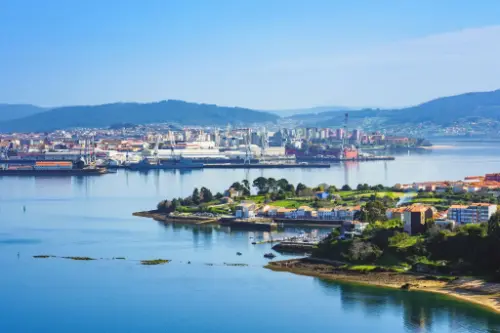
Ferrol / Hiszpania
-
Dzień 14:
Dzień na morzu / Morze
-
 Dzień 15: 07:30–18:00
Saint-Malo / Francja
Morska bryza i krzyki mew towarzyszą Ci w Saint-Malo, mieście na wybrzeżu Bretanii, które zachowało ducha morskich przygód i niezależności. Wysokie mury obronne otaczają tu wąskie uliczki, a brukowane ścieżki prowadzą do przytulnych kawiarni z widokiem na ocean. Historia piratów i żeglarzy ożywa, gdy spacerujesz po bastionach, obserwujesz, jak przypływy zmieniają linię brzegową, lub wybierasz się łodzią na słynną wyspę Grand Bé, gdzie pochowany jest pisarz Chateaubriand.
W Saint-Malo możesz cieszyć się świeżymi owocami morza w lokalnych restauracjach, spróbować ostryg złowionych w pobliskich wodach lub urządzić piknik na piaszczystych plażach, które odsłaniają się podczas odpływu. Miasto daje poczucie jednoczesnego spokoju i wolności, łącząc malowniczą architekturę z energią Atlantyku, a morski wiatr i zapach soli w powietrzu przypominają, że tutaj historia i natura są zawsze blisko.
-
 Dzień 16: 07:30–18:00
Honfleur / Francja
Honfleur jest gminą w departamencie Calvados w północno-zachodniej Francji. Położone jest na południowym brzegu ujścia Sekwany, naprzeciwko Le Havre i bardzo blisko wyjazdu z Pont de Normandie. Jego mieszkańców nazywa się Honfleurais.
Jest szczególnie znane ze swojego starego, pięknego, malowniczego portu, charakteryzującego się domami z fasadami pokrytymi łupkiem, wielokrotnie malowanymi przez artystów, w tym w szczególności Gustave'a Courbeta, Eugène'a Boudina, Claude'a Moneta i Johana Jongkinda, tworzących École de Honfleur (szkołę honfleurską), która przyczyniła się do powstania ruchu impresjonistycznego. Kościół Sainte-Catherine, którego dzwonnica jest oddzielona od głównego budynku, jest największym drewnianym kościołem we Francji.
-
 Dzień 17: 08:00–22:00
Дувр / Wielka Brytania
Dover is a major ferry port in Kent, South East England. It faces France across the Strait of Dover, the narrowest part of the English Channel, and lies south-east of Canterbury and east of Maidstone. The town is the administrative centre of the Dover District and home of the Dover Calais ferry through the Port of Dover. The surrounding chalk cliffs are known as the White Cliffs of Dover.
Archaeological finds have revealed that the area has always been a focus for peoples entering and leaving Britain. The name derives from the River Dour that flows through it.
The Port of Dover provides much of the town's employment, as does tourism.
-
 Dzień 18: 08:00–20:00
Bruges / Belgia
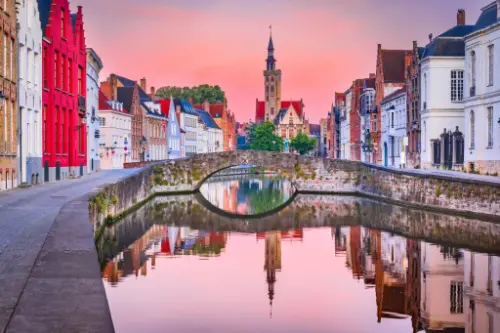
Bruges is the capital and largest city of the province of West Flanders in the Flemish Region of Belgium, in the northwest of the country.
The area of the whole city amounts to more than 13,840 hectares (138.4 sq km; 53.44 sq miles), including 1,075 hectares off the coast, at Zeebrugge (from Brugge aan zee, meaning "Bruges by the Sea"). The historic city centre is a prominent World Heritage Site of UNESCO. It is oval in shape and about 430 hectares in size. The city's total population is 117,073 (1 January 2008), of whom around 20,000 live in the city centre. The metropolitan area, including the outer commuter zone, covers an area of 616 km2 (238 sq mi) and has a total of 255,844 inhabitants as of 1 January 2008.
Along with a few other canal-based northern cities, such as Amsterdam, it is sometimes referred to as the Venice of the North. Bruges has a significant economic importance, thanks to its port, and was once one of the world's chief commercial cities. Bruges is well known as the seat of the College of Europe, a university institute for European studies.
-
 Dzień 19: 08:00–17:00
Amsterdam / Holandia
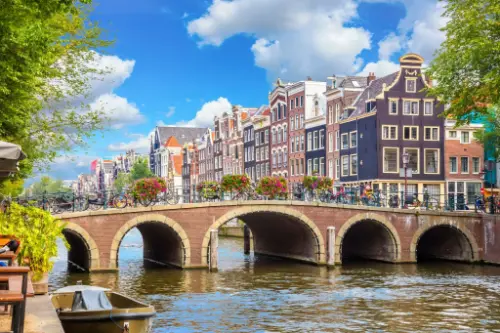
Największe handlowe miasto Niderlandów — Amsterdam zostało założone w odległym 1275 roku i swoim pochodzeniem, jak i nazwą, zawdzięcza tamie, która w swoim czasie zabezpieczyła okolice przed powodziami („tama na rzece Amstel”). To najsłynniejsze na cały świat miasto może poszczycić się wieloma zabytkami. Na tę szeroką listę wchodzą centralna ulica Damrak, place Dam i Leidseplein, Pałac Królewski, słynne kościoły Nieuwe i Oude Kerk. Również w Amsterdamie można znaleźć liczne muzea, które wywołają ogromne zainteresowanie u wszystkich gości miasta: muzeum Van Gogha, muzea sztuki nowoczesnej i figur woskowych, dom-muzeum Anny Frank, a nawet muzeum seksu. Spacerując po mieście, będą mogli Państwo podziwiać most Magere Brug, wieżę Montelbaanstoren i wiele innych.
Ale nie tylko to przyciąga tutaj tłumy turystów. W szczególności młodzież przyjeżdża tutaj, ponieważ jest to jedna ze stolic handlowych świata, wielu przyciągają miejscowe coffeeshopy, gdzie można spróbować ciasteczek z marihuaną, a innych wabi nieskończona liczba nocnych klubów. Oczywiście wszystko to kusi i intryguje, ale jest jedna niezwykła, w szczególny sposób pociągająca atrakcja — niewiarygodna atmosfera tego miasta.
-
 Dzień 20: 13:30
Hamburg / Niemcy
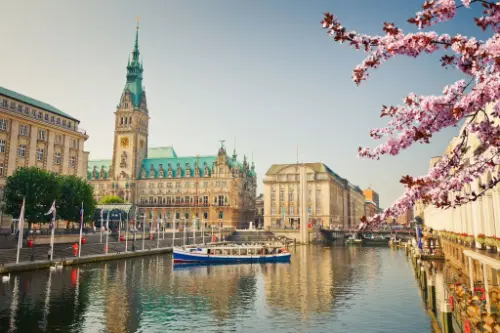
Hamburg ; officially the Free and Hanseatic City of Hamburg is the second-largest city in Germany with a population of over 1.8 million.
One of Germany's 16 federal states, it is surrounded by Schleswig-Holstein to the north and Lower Saxony to the south. The city's metropolitan region is home to more than five million people. Hamburg lies on the River Elbe and two of its tributaries, the River Alster and the River Bille.
-
Dzień 21: 20:00
Hamburg / Niemcy
Hamburg ; officially the Free and Hanseatic City of Hamburg is the second-largest city in Germany with a population of over 1.8 million.
One of Germany's 16 federal states, it is surrounded by Schleswig-Holstein to the north and Lower Saxony to the south. The city's metropolitan region is home to more than five million people. Hamburg lies on the River Elbe and two of its tributaries, the River Alster and the River Bille.
-
 Dzień 22: 06:00–18:00
Kanał Kiloński / Niemcy
-
 Dzień 23: 08:00–18:00
Fredericia / Denmark
-
 Dzień 24: 06:00–17:00
Kopenhaga / Denmark
the capital and chief port of Denmark, a city that occupies the eastern part of Zealand and northern part of the island of Amager; population 518,574 (2009).
-
 Dzień 25: 14:00
Gdańsk / Polska
-
Dzień 26: 20:00
Gdańsk / Polska
-
 Dzień 27: 07:30–14:00
Kłajpeda (Memel) / Litwa
Klaipėda is a city in Lithuania on the Baltic Sea coast. It is the third largest city in Lithuania and the capital of Klaipėda County.
The city has a complex recorded history, partially due to the combined regional importance of the usually ice-free Port of Klaipėda at the mouth of the Akmena-Danė River. It was controlled by successive German states until the 1919 Treaty of Versailles. As a result of the 1923 Klaipėda Revolt it was added to Lithuania and has remained with Lithuania to this day, except for the period between 1939 and 1945 when it returned to Germany following the 1939 German ultimatum to Lithuania and the German–Soviet Union Molotov–Ribbentrop Pact.
The population has shrunk from the city to suburbs and the hinterland. The city had a population of 207,100 in 1992 to 157,350 in 2014 but the city is growing again. Popular seaside resorts found close to Klaipėda are Nida to the south on the Curonian Spit and Palanga to the north.
-
 Dzień 28: 08:00–22:00
Ryga / Łotwa
Riga is the capital and largest city of Latvia. With 637,827 inhabitants (2018), it is also the largest city in the three Baltic states, home to one third of Latvia's population and one tenth of the three Baltic states' combined population. The city lies on the Gulf of Riga, at the mouth of the Daugava. Riga's territory covers 307.17 km2 (118.60 sq mi) and lies 1–10 m (3 ft 3 in–32 ft 10 in) above sea level, on a flat and sandy plain.
Riga was founded in 1201 and is a former Hanseatic League member. Riga's historical centre is a UNESCO World Heritage Site, noted for its Art Nouveau/Jugendstil architecture and 19th century wooden architecture. Riga was the European Capital of Culture during 2014, along with Umeå in Sweden. Riga hosted the 2006 NATO Summit, the Eurovision Song Contest 2003, the 2006 IIHF Men's World Ice Hockey Championships and the 2013 World Women's Curling Championship. It is home to the European Union's office of European Regulators for Electronic Communications (BEREC).
In 2016, Riga received over 1.4 million visitors. It is served by Riga International Airport, the largest and busiest airport in the Baltic states. Riga is a member of Eurocities, the Union of the Baltic Cities (UBC) and Union of Capitals of the European Union (UCEU).
-
Dzień 29:
Dzień na morzu / Morze
-
 Dzień 30: 08:00–22:00
Tallinn / Estonia
Tallinn is the capital and largest city of Estonia. It is on the northern coast of the country, on the shore of the Gulf of Finland in Harju County. From the 13th century until 1918 (and briefly during the Nazi occupation of Estonia from 1941 to 1944), the city was known as Reval. Tallinn occupies an area of 159.2 km2 (61.5 sq mi) and has a population of 453,033.
Tallinn, first mentioned in 1219, received city rights in 1248, but the earliest human settlements date back 5,000 years. The initial claim over the land was laid by the Danes in 1219, after a successful raid of Lindanise led by Valdemar II of Denmark, followed by a period of alternating Scandinavian and German rule. Due to its strategic location, the city became a major trade hub, especially from the 14th to the 16th century, when it grew in importance as part of the Hanseatic League.
-
 Dzień 31: 08:00–22:00
Helsinki / Finland
Helsinki located in the southern Finland, and has a population of 648,650. The city's urban area has a population of 1,268,296, it’s the most important center for politics, education, finance, culture, and research. Helsinki is located 80 kilometers (50 mi) north of Tallinn, Estonia, 400 km (250 mi) east of Stockholm, Sweden, and 390 km (240 mi) west of Saint Petersburg, Russia. It has close ties with these three cities.
Together with the cities of Espoo, Vantaa, and Kauniainen, and the surrounding commuter towns, Helsinki forms the Greater Helsinki metropolitan area, which has a population of nearly 1.5 million. Often being considered a metropolis of the EU member state. After Stockholm and Oslo, Helsinki is the third largest city in the Nordic countries. It is located in the city of Vantaa and is located in the city of Vantaa.
Helsinki was the World Design Capital for 2012, the 1952 Summer Olympics and the 52nd Eurovision Song Contest.
-
 Dzień 32: 08:00–21:00
Turku / Finland
Przytulny północny rytm można poczuć w każdym zakątku Turku, najstarszego miasta Finlandii, założonego w XIII wieku. Tutaj przeszłość spotyka się z teraźniejszością: brukowane uliczki, katedra Turku, średniowieczny zamek i przytulne kawiarnie nad rzeką tworzą atmosferę, w której chce się zatrzymać i niespiesznie odkrywać każdy zakręt rzeki Aura.
Latem Turku ożywa festiwalami, wieczorami muzycznymi i rejsami łodziami, pozwalając poczuć urok fińskiego życia nadmorskiego. Zimą miasto rozświetlają delikatne światła, jarmarki bożonarodzeniowe i ciepła atmosfera, gdzie podróżnicy mogą cieszyć się tradycyjną fińską sauną i kuchnią, odkrywając Finlandię z jej najcieplejszej strony.
-
 Dzień 33: 09:00–17:00
Mariehamn, Wyspy Alandzkie / Finland
Położone wśród malowniczych wód Morza Bałtyckiego i unikalnej przyrody archipelagu, Mariehamn Wyspy Alandzkie to prawdziwy raj wyspowy dla tych, którzy szukają spokoju i piękna. To miejsce słynie z bogatej historii morskiej, przytulnych uliczek i uroczych drewnianych domów, a także licznych muzeów i wydarzeń kulturalnych ukazujących wyjątkowość tego regionu.
Miłośnicy przyrody i aktywnego wypoczynku docenią wiele możliwości do wędrówek, jazdy na rowerze oraz żeglowania. Wokół Mariehamn Wyspy Alandzkie rozciągają się rezerwaty przyrody z różnorodną florą i fauną, a lokalne restauracje zapraszają do spróbowania najświeższych owoców morza oraz tradycyjnych potraw. Tutaj można całkowicie zanurzyć się w atmosferę spokoju i autentycznego północnego stylu życia.
-
 Dzień 34: 08:00
Sztokholm / Sweden
Stockholm is the capital of Sweden and the most populous urban area in the Nordic countries; 960,031 people live in the municipality, approximately 1.5 million in the urban area, and 2.3 million in the metropolitan area. The city stretches across fourteen islands where Lake Mälaren flows into the Baltic Sea. Just outside the city and along the coast is the island chain of the Stockholm archipelago. The area has been settled since the Stone Age, in the 6th millennium BC, and was founded as a city in 1252 by Swedish statesman Birger Jarl. It is also the capital of Stockholm County.
Stockholm is the cultural, media, political, and economic centre of Sweden. The Stockholm region alone accounts for over a third of the country's GDP, and is among the top 10 regions in Europe by GDP per capita. It is an important global city, and the main centre for corporate headquarters in the Nordic region. The city is home to some of Europe's top ranking universities, such as the Stockholm School of Economics, Karolinska Institute and Royal Institute of Technology (KTH). It hosts the annual Nobel Prize ceremonies and banquet at the Stockholm Concert Hall and Stockholm City Hall. One of the city's most prized museums, the Vasa Museum, is the most visited non-art museum in Scandinavia. The Stockholm metro, opened in 1950, is well known for the decor of its stations; it has been called the longest art gallery in the world. Sweden's national football arena is located north of the city centre, in Solna. Ericsson Globe, the national indoor arena, is in the southern part of the city. The city was the host of the 1912 Summer Olympics, and hosted the equestrian portion of the 1956 Summer Olympicsotherwise held in Melbourne, Victoria, Australia.
Stockholm is the seat of the Swedish government and most of its agencies, including the highest courts in the judiciary, and the official residencies of the Swedish monarch and the Prime Minister. The government has its seat in the Rosenbad building, the Riksdag (Swedish parliament) is seated in the Parliament House, and the Prime Minister's residence is adjacent at Sager House. Stockholm Palace is the official residence and principal workplace of the Swedish monarch, while Drottningholm Palace, a World Heritage Site on the outskirts of Stockholm, serves as the Royal Family's private residence.
-
Dzień 35: 08:00
Sztokholm / Sweden
Stockholm is the capital of Sweden and the most populous urban area in the Nordic countries; 960,031 people live in the municipality, approximately 1.5 million in the urban area, and 2.3 million in the metropolitan area. The city stretches across fourteen islands where Lake Mälaren flows into the Baltic Sea. Just outside the city and along the coast is the island chain of the Stockholm archipelago. The area has been settled since the Stone Age, in the 6th millennium BC, and was founded as a city in 1252 by Swedish statesman Birger Jarl. It is also the capital of Stockholm County.
Stockholm is the cultural, media, political, and economic centre of Sweden. The Stockholm region alone accounts for over a third of the country's GDP, and is among the top 10 regions in Europe by GDP per capita. It is an important global city, and the main centre for corporate headquarters in the Nordic region. The city is home to some of Europe's top ranking universities, such as the Stockholm School of Economics, Karolinska Institute and Royal Institute of Technology (KTH). It hosts the annual Nobel Prize ceremonies and banquet at the Stockholm Concert Hall and Stockholm City Hall. One of the city's most prized museums, the Vasa Museum, is the most visited non-art museum in Scandinavia. The Stockholm metro, opened in 1950, is well known for the decor of its stations; it has been called the longest art gallery in the world. Sweden's national football arena is located north of the city centre, in Solna. Ericsson Globe, the national indoor arena, is in the southern part of the city. The city was the host of the 1912 Summer Olympics, and hosted the equestrian portion of the 1956 Summer Olympicsotherwise held in Melbourne, Victoria, Australia.
Stockholm is the seat of the Swedish government and most of its agencies, including the highest courts in the judiciary, and the official residencies of the Swedish monarch and the Prime Minister. The government has its seat in the Rosenbad building, the Riksdag (Swedish parliament) is seated in the Parliament House, and the Prime Minister's residence is adjacent at Sager House. Stockholm Palace is the official residence and principal workplace of the Swedish monarch, while Drottningholm Palace, a World Heritage Site on the outskirts of Stockholm, serves as the Royal Family's private residence.
Organizator
Biznes i Turystyka Piotr Skupiewski
- ul. Łukowa 41, 32-823 Szczepanów
- NIP 8691148381
- REGON 850455159
- +48 576 977 555
- +48 570 700 273
Organizator jest wpisany do Centralnej Ewidencji Organizatorów Turystyki i Przedsiębiorców Ułatwiających Nabywanie Powiązanych Usług Turystycznych. Posiada gwarancję ubezpieczeniową UNIQA nr 3800003856, ważną od 5 maja 2026 r. do 4 maja 2027 r. Suma gwarancyjna wynosi 379 404,00 zł. Organizator odprowadza składki do Turystycznego Funduszu Gwarancyjnego i Turystycznego Funduszu Pomocowego.
Częste pytania
Rekomendujemy przylot dzień przed rozpoczęciem rejsu.
- W porcie należy stawić się 2–3 godziny przed wypłynięciem.
- Zamawiając transfer lotnisko–port, zaplanuj co najmniej 5 godzin między lądowaniem a planowanym wypłynięciem.
Masz jeszcze pytania?
Pomożemy wybrać rejs i odpowiemy na Twoje pytania.