Greece can be reached by ship in two ways, and they differ in length rather than price.
The first sails from Piraeus, the port of Athens: the islands begin on day one and there are more of them. The second runs from Italy, where Greece turns up in the second half of the week — usually Corfu, sometimes Santorini, and that is all.
The number of sailings on offer sits above the list and moves with the operators’ inventory; below we explain how to tell the two apart and how much time an island call really leaves you.
Piraeus and the island ports
Piraeus lies a dozen kilometres from central Athens and is linked to the city by metro. It is the easiest start to combine with the Acropolis beforehand — two days in Athens before boarding is the arrangement most of our clients recommend.
Santorini is a tender port: the ship lies at anchor in the caldera and you go up by cable car or on foot. The cable car queue can be long, so the town itself gets less time than the schedule suggests.
Mykonos and Crete have berths, so you step straight ashore. On Crete the port of Heraklion is beside the town, but Knossos is twenty minutes further out — without transport you will not make it.
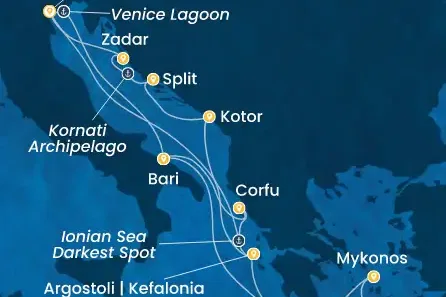
Corfu is the commonest Greek call on Italian itineraries. The old town sits right by the port, so even a short call is worth it; and on Italian itineraries it is usually the only Greek call in the whole week. Two Venetian fortresses and the promenade are within an easy walk of the quay, which makes Corfu one of the few calls where a six-hour stop is genuinely enough.
Check-in closes two to three hours before departure, and being at the port well ahead of that limit is the safe reading of it. The five-hour figure belongs only to a transfer arranged by the cruise line and has nothing to do with the port itself.
| Port | What it offers |
|---|
| Piraeus (Athens) | The port of Athens, metro to the centre. The usual start for island routes. |
| Santorini | A tender port in the caldera. A cable car up top, less time for the town itself. |
| Mykonos | A berth beside the town. Old town and beaches within a walk or a short transfer. |
| Heraklion | The port adjoins the town, but Knossos is twenty minutes out — you need transport. |
| Corfu | The commonest Greek call on Italian routes. The old town is right by the quay. |
How much time an island call really leaves
A ship is usually in port for eight to ten hours, but that time runs from mooring to the moment you must be back aboard, not to departure. You return half an hour early, so in practice you have an hour less than the schedule shows.
In tender ports, subtract the boat ride both ways and the queue for it. On Santorini it is safe to count on five or six hours ashore rather than the nine in the timetable.
On Mykonos the ships normally berth in the new port, some two kilometres from the town. A shuttle bus runs from there, but at the height of the season you queue for it — add a quarter of an hour each way to what the timetable shows as a full day.
That is why itineraries from Piraeus, with four or five islands, give less time at each and more places; Italian ones do the opposite. The choice is between seeing a lot and seeing calmly.
Timetables also change mid-cruise: the captain shortens a call to make up time or ahead of worsening weather. It is usually the tender port that gets cut, because going ashore takes longest there — another reason not to book anything for a fixed hour on Santorini.
A shore excursion in each port is paid separately. In Greece it pays more often than elsewhere to buy one on board in tender ports: passengers with an excursion go ashore first.
When to sail to Greece
The season runs from April to October. July and August are the hottest, and Santorini and Mykonos then have several ships in at once — the narrow streets do not take it well.
May, June and September are the best compromise: the water is warm already or still, the heat is bearable and fares are below the peak. September is often quieter than June.
The meltemi, the strong northerly wind, blows mainly in July and August and can cancel a landing in a tender port. It is not frequent, but it happens precisely at the height of the season.
Orthodox Easter usually falls later than the Western one and is the largest holiday in Greece: some shops and museums close and the towns fill up. If your sailing falls in that week, it is worth knowing before you book any excursions.
Out of season, sailings from Piraeus all but disappear. In winter Greece shows up only as a single call on longer routes in the eastern basin.
Who sells this and who is responsible
The organiser is Piotr Skupiewski, trading as Biznes i Turystyka Piotr Skupiewski, with its registered office at ul. Łukowa 41, 32-823 Szczepanów, Poland; NIP: 869-114-83-81, REGON: 850455159.
The organiser is entered in the Central Register of Tour Operators and Entrepreneurs Facilitating the Purchase of Linked Travel Arrangements (CEOTiPUNPUT). It holds an insurance guarantee, UNIQA nr 3800003856, valid from 5 May 2026 to 4 May 2027. The sum guaranteed is PLN 379,404.00.
The contract is concluded in euros or US dollars, depending on the booking. Payment can be made by transfer in euros or in zloty. Payments made through the payment link are settled in zloty. We do not offer instalment payments.
The contract is with us, not with a foreign intermediary.
At Center Cruises we answer the telephone in Polish between 9:00–18:00 on +48 576 977 555. We do not vanish once you have paid: a cabin change, a question about paperwork or a problem during the sailing is still ours to handle.