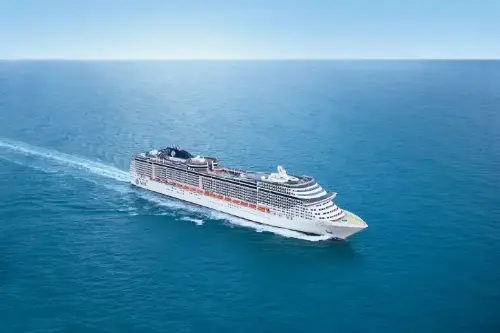
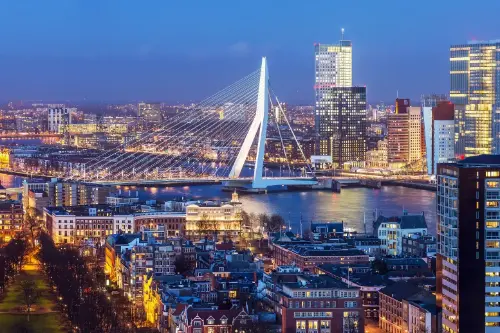
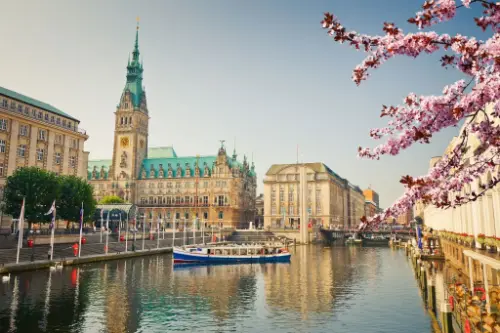
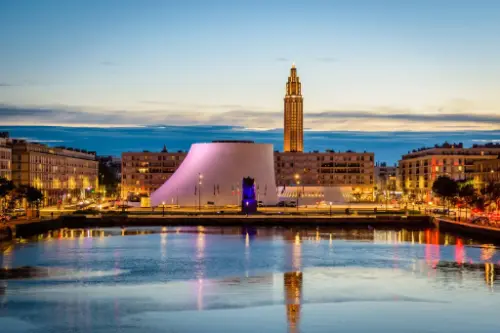
The ports of Warnemünde and Kiel can be reached comfortably by car from western Poland, with no need to arrange a flight or additional transfers.
Along with the Baltic itself, this is one of the most easily reachable cruise destinations for travellers from Central Europe. The ports are much closer than Genoa, and the journey can be planned without airport connections or complicated logistics.
Below we explain how the three quite different kinds of holiday sold under the common name of Northern Europe cruises differ from one another. We also show which ports the ships depart from, when it is best to plan the cruise, and what is genuinely worth taking on board.
The Norwegian fjords. Geiranger, Flåm, Ålesund and Bergen are among the most spectacular places in northern Europe. The steep fjord walls, the waterfalls and a ship sailing deep between the mountains create a landscape that is hard to experience any other way. It is the most scenic variant and one of the most common choices for a first Northern Europe cruise.
The Baltic and its capitals. Copenhagen, Stockholm, Helsinki, Tallinn, Riga and Klaipėda are a proposition for people who prefer cities, museums and historic centres to raw nature. Each day brings a different place to explore, and an additional advantage is the easy journey to ports located relatively close to Poland.
The far north: Iceland, Greenland, Svalbard. Volcanoes, glaciers, the polar day, and ports that are hard to reach on an ordinary overland journey. These cruises are longer, more expensive and organised far less often, so it is worth planning them well in advance — often around a year ahead.
The choice of port has a major influence on the logistics of the whole trip. From Warnemünde or Hamburg you can comfortably return home on the very day the cruise ends. For Reykjavik, on the other hand, you need to allow for a flight, and often also an additional night before the cruise or after it ends.
| Port | What it offers |
|---|---|
| Warnemünde | The closest to Poland. From the western part of the country it can be reached by car in a few hours, with no need to use an airport. |
| Copenhagen | The classic starting point for fjord cruises. It can be reached by car or by air, and the city itself is well worth including in the plan for an extra day. |
| Hamburg | A good port for longer routes north, including towards Svalbard. Driving from Poland is possible, though it takes more time than the journey to Warnemünde. |
| Reykjavik | Iceland and Greenland. Reykjavik is most conveniently reached by air, but in exchange you gain access to exceptional routes running through some of the most spectacular landscapes of the North Atlantic. |
Cruise ships call at Gdynia on Baltic itineraries, often alongside ports such as Klaipėda and Riga. So large cruise vessels can also be seen in Polish ports.
That, however, is something different from starting a cruise. The cruises we offer do not begin in Gdynia or Gdańsk. If an offer mentions a “departure from Poland”, it usually means coach transport to a port in Germany, from which the ship then sails.
It is worth keeping the distinction in mind, because the way you reach the port has a real effect on the travel time, the comfort and the total cost of the trip.
The cruise season in the north of Europe is relatively short and runs mainly from May to September. The widest choice of routes falls in July and August. Once the season ends, most ships move to the Mediterranean, the Caribbean and other warmer waters, so the number of available cruises drops noticeably.
June and July are the best time for people who care about very long days and the maximum amount of light. In the far north you can then experience the polar day, when the sun stays above the horizon around the clock.
May and September are usually cooler, but often also more attractively priced. An additional advantage is less crowded ports and calmer sightseeing.
This is not a beach holiday. Even at the height of the season, temperatures in the fjords are often in the mid-teens, and the weather can change quickly. Rain, wind and cooler days are normal, so a good waterproof jacket and a warmer layer of clothing genuinely come in useful. The pool on board can be a bonus, but it should not be the main reason for choosing this kind of cruise.
Norway and Iceland are among the more expensive destinations in Europe. A coffee in port, a taxi ride or a railway ticket can cost noticeably more than in Croatia or Spain. It is worth allowing for these expenses before the trip, especially if you plan to explore the ports independently.
Shore excursions organised by the operator often make more sense here than on other routes. Some of the most interesting sights lie far from the port, and the ship's time in port is limited. In such places, organised transport reduces the risk of missing the ship and lets you see more without nervously watching the clock. It is one of those destinations where it is not always worth arranging everything yourself.
The organiser is Biznes i Turystyka Piotr Skupiewski (BIT Travel), with its registered office at ul. Łukowa 41, 32-823 Szczepanów, NIP 869-114-83-81, REGON 850455159.
The company is entered in the Central Register of Tour Operators and Entrepreneurs Facilitating the Purchase of Linked Travel Arrangements (CEOTiPUT) and pays the required contributions to the Tourism Guarantee Fund (TFG) and the Tourism Assistance Fund (TFP).
We hold insurance guarantee UNIQA no. 3800003856 for PLN 379,404.00, valid from 05.05.2026 to 04.05.2027.
The documents confirming this financial protection can be downloaded at the foot of this page.
Telephone: +48 576 977 555
We serve clients in Polish between 9:00 and 18:00.
The contract is concluded in euros or US dollars, depending on the booking. Payment can be made by transfer in euros or in zloty. Payment via the payment link is processed in PLN only.
We do not offer instalment payments.
On Northern Europe cruises we most often help with two things: choosing the right date, and planning the journey to the port and back to Poland. It is worth reaching the port 2–3 hours before the scheduled departure. If you plan a transfer from the airport to the port, at least 5 hours should remain between landing and departure. Well-planned logistics can save an extra night, hours of waiting and a night-time drive across Germany. That is why it is worth talking these matters through before making the booking.
Do Baltic or fjord cruises start in Gdynia?
No. Ships call at Gdynia on Baltic itineraries, but regular cruise departures do not begin there.
The nearest popular embarkation ports are Warnemünde and Kiel on the German side, plus Copenhagen.
If an offer mentions a “cruise from Gdynia”, it is worth checking whether it in fact means coach transport to a German port.
Fjords or the Baltic — which one?
Choose the fjords if landscape matters to you: waterfalls, steep mountainsides and deep valleys the ship sails into.
The Baltic is the better choice if you prefer cities — Copenhagen, Stockholm, Helsinki, Tallinn and Riga in a single itinerary.
The fjords make the greater impression the first time; the Baltic is easier logistically and often better value.
How long is the drive to the port?
Warnemünde is a few hours by car from western Poland, and Hamburg correspondingly further. It is one of the few cruise destinations where a flight is optional.
Terminal parking is booked separately. We can help check its availability for your dates. It is worth reaching the port 2–3 hours before the scheduled departure. If you plan a transfer from the airport to the port, at least 5 hours should remain between landing and departure.
When does the cruise season run?
The season lasts mainly from May to September, with the widest choice of routes in July and August. Outside that window the number of cruises drops noticeably, as most ships move to warmer waters.
Demand is compressed into a few months, so the better cabins on fjord sailings sell early — often around a year in advance. Last-minute offers do appear, but the choice is then much smaller.
If your leave is tied to the school holidays, it is worth treating an early booking as part of the plan.
What is the weather like and what should I pack?
Even at the height of the season, temperatures in the fjords are often in the mid-teens, with frequent rain and wind.
You need a waterproof jacket, a warm layer and comfortable shoes — the pool is rarely the point of this cruise. It is also worth packing something smart for the evening: on many ships an evening dress code applies regardless of the weather outside.
Are the line's shore excursions worth buying?
On northern routes, often yes. Some sights lie far from the berth, and the ship's time in port can be limited, so organised transport reduces the risk of missing the ship and lets you see more.
On city calls such as Copenhagen or Tallinn, independent sightseeing is very easy.
Can I see Iceland on a week-long cruise?
Usually not. Itineraries that include Iceland — and especially Iceland together with Greenland — tend to be longer than the classic week-long routes, and you also need to allow for the flight to Reykjavik and often an additional night.
A week is the natural format for the fjords and the Baltic, where the distances between ports are smaller.
Who is responsible for my booking if something goes wrong?
The organiser is Biznes i Turystyka Piotr Skupiewski — a Polish company entered in the CEOTiPUT register, paying contributions to the Tourism Guarantee Fund and the Tourism Assistance Fund.
The company holds insurance guarantee UNIQA no. 3800003856, valid until 04.05.2027.
The telephone is answered in Polish between 9:00 and 18:00.