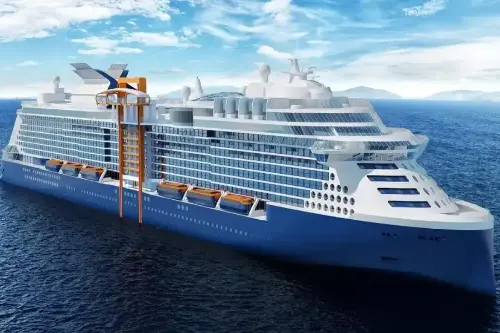
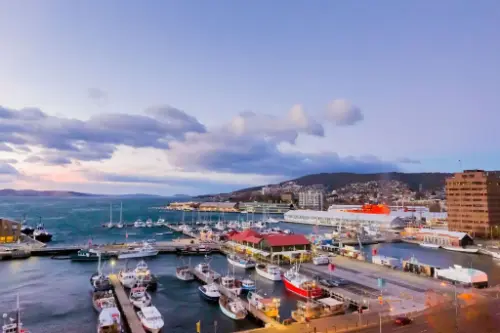
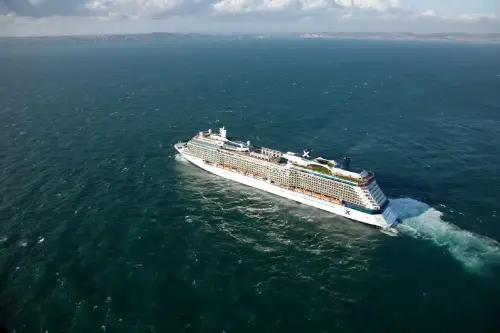
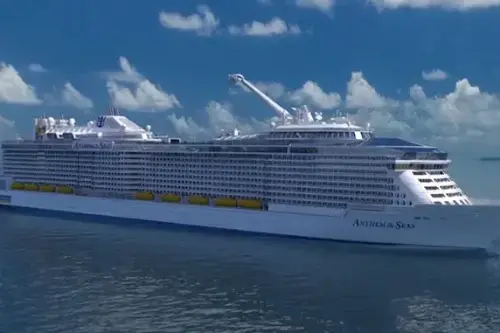
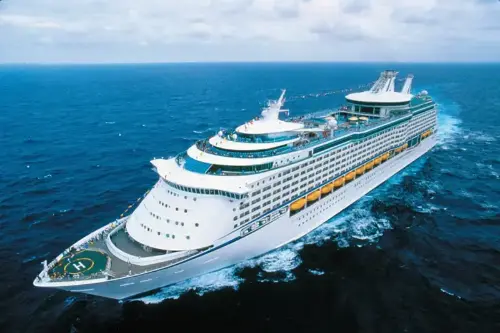
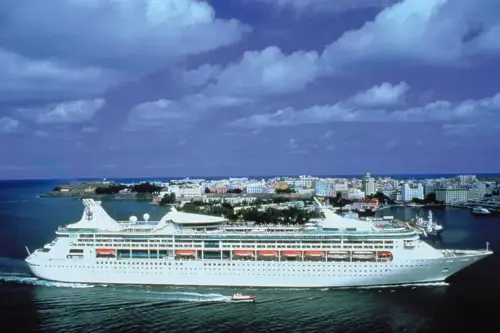
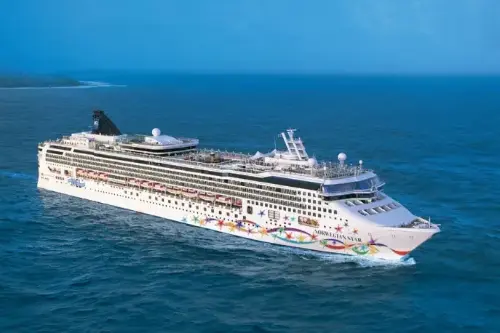
Twice a year the lines move their ships between cruising areas — and sell those crossings to passengers.
That produces the repositioning cruise: a ship finishes the season in one sea and has to reach the place where the next one starts. The route runs one way, the stretches without land can be long, and the price per night works out differently from a round trip, because the ship has to cover that distance anyway.
A transatlantic cruise is the best known version of the format, though not the only one. Below we cover when and where these crossings run, how to read the list of offers, whom the format suits and whom it does not, and how to arrange the flights when you come home from a different continent than the port you sailed from. The seller is a Polish agency: Biznes i Turystyka, phone +48 576 977 555, answered in Polish between 9:00–18:00.
When and where
The calendar is predictable, because it follows the seasons rather than a promotion. In autumn the ships leave Europe westward: from Barcelona, Civitavecchia or Southampton through Gibraltar, Madeira and the Azores to Florida, New York or Galveston. In spring the same road runs the other way.
The northern route keeps to higher latitudes and ends in Halifax or New York; the southern one drops towards Bermuda and the Gulf coast. The difference is real: the north brings rougher weather, the south is calmer and the passage a day longer.
Beyond the Atlantic the lines reposition ships on other oceans too, and all of those crossings land in the same list. The dates are known well in advance, so on these routes people usually book about six months ahead.
How to read this list
We will say it plainly: the list under this filter holds more than Atlantic passages. It gathers every repositioning sailing, including those across the Pacific — Vancouver to Los Angeles, Honolulu to Sydney, and between Yokohama and Los Angeles.
That is not a fault in the offer but the way the catalogue groups sailings: the criterion is the seasonal move of a ship rather than the body of water — which is why short coastal hops and round trips in distant waters sit here alongside ocean crossings. We have flagged it for correction, and until the category is split the simplest check is the departure port and the destination on the card of a given sailing — those settle which ocean you cross.
We write this instead of pretending the list is uniform, because you will notice it in the first minute of browsing and you are better off knowing in advance.
Whom it suits and whom it does not
The format rewards people who enjoy being aboard. Successive days without land mean lectures, a library, the pool, the theatre and unhurried meals — exactly what part of the market boards a ship for. If that is you, an ocean crossing will be exactly the cruise for you.
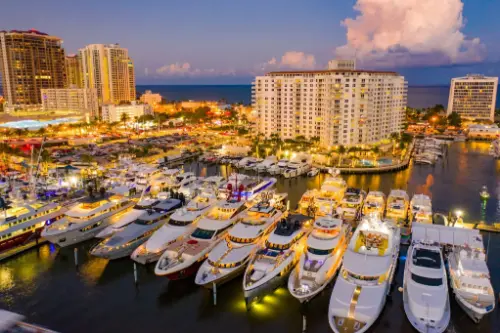
We do not recommend it as a first cruise. Anyone unsure how they take several days without going ashore will find out in mid-ocean, where getting off is not an option. For a trial, short sailings from Florida serve better: three or five nights, with a stop almost every day.
We also advise against it when the return date is fixed. An Atlantic crossing most often runs from twelve to seventeen nights, and the line may adjust the schedule for weather on the open ocean. The shorter entries under this filter — from three nights — are not crossings but coastal hops and round trips.
The logistics of a one-way flight
The cruise ends on another continent, so the air ticket is a one-way one — and that surprises people more often than the length of the sailing does. Two single tickets usually cost more than an ordinary return, and on the autumn route the time difference is added to that.
The practice is simple: land a day before embarkation, and fly home no sooner than a day after leaving the ship. The ticket is not part of the cruise price; we arrange it alongside the booking so that the timings line up and you do not discover that the ship ends its voyage in the morning while the aircraft leaves at noon from an airport on the far side of the city.
Baggage counts differently as well. You sail out of one climate and step ashore in another, so one suitcase has to serve both ends of the route at once.
Check-in closes two to three hours before departure, and being at the port well ahead of that limit is the safe reading of it. The five-hour figure belongs only to a transfer arranged by the cruise line and has nothing to do with the port itself.
| Port | What this call is |
|---|
| Funchal | The last port before the long stretch or the first one after it. Greenery and wine rather than a beach. |
| Ponta Delgada | The middle of the ocean with a view of volcanoes. A short call, as the ship is making up time. |
| Vigo | A call on northern routes, close to Santiago de Compostela. |
| Lisbon | A frequent starting port for autumn crossings, and an easy flight from Poland. |
| Gibraltar | The narrow gate between sea and ocean. A symbolic stop rather than a long one. |
| Halifax | The first land on the American side on northern routes. |
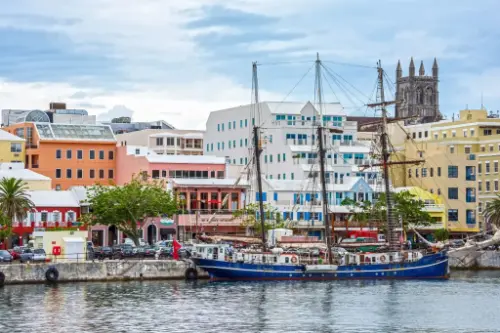
| Hamilton | The warmer variant, found on crossings that end on the eastern seaboard. |
Who sells this and who is responsible
The organiser is Piotr Skupiewski, trading as Biznes i Turystyka Piotr Skupiewski, with its registered office at ul. Łukowa 41, 32-823 Szczepanów, Poland; NIP: 869-114-83-81, REGON: 850455159.
The organiser is entered in the Central Register of Tour Operators and Entrepreneurs Facilitating the Purchase of Linked Travel Arrangements (CEOTiPUNPUT). It holds an insurance guarantee, UNIQA nr 3800003856, valid from 5 May 2026 to 4 May 2027. The sum guaranteed is PLN 379,404.00.
The contract is concluded in euros or US dollars, depending on the booking. Payment can be made by transfer in euros or in zloty. Payments made through the payment link are settled in zloty. We do not offer instalment payments.
Call +48 576 977 555; the line is answered in Polish between 9:00–18:00.
On a route this long the seller’s part does not end with issuing the documents. At Center Cruises we handle all of it in Polish, from the online check-in and the travel documents, through a change of cabin number or grade, to questions about the full payment and contact with the line. Online check-in on its own does not release you from registering at the port, and we say so up front.